Chinatown
Guide to Toronto's Chinatown along Spadina Avenue: where to eat, how it connects to Kensington Market, and what makes it different from the suburban
Toronto: 2-Hour Kensington Market Chinatown Walking Tour
Quick facts
- Best base for
- Cantonese and pan-Asian food, dumplings, cheap eats
- Nearest transit
- 510 Spadina streetcar, Dundas station
- Main strip
- Spadina Avenue between Dundas and College
- Character
- Toronto's original, still-active downtown Chinatown
Toronto’s original downtown Chinatown
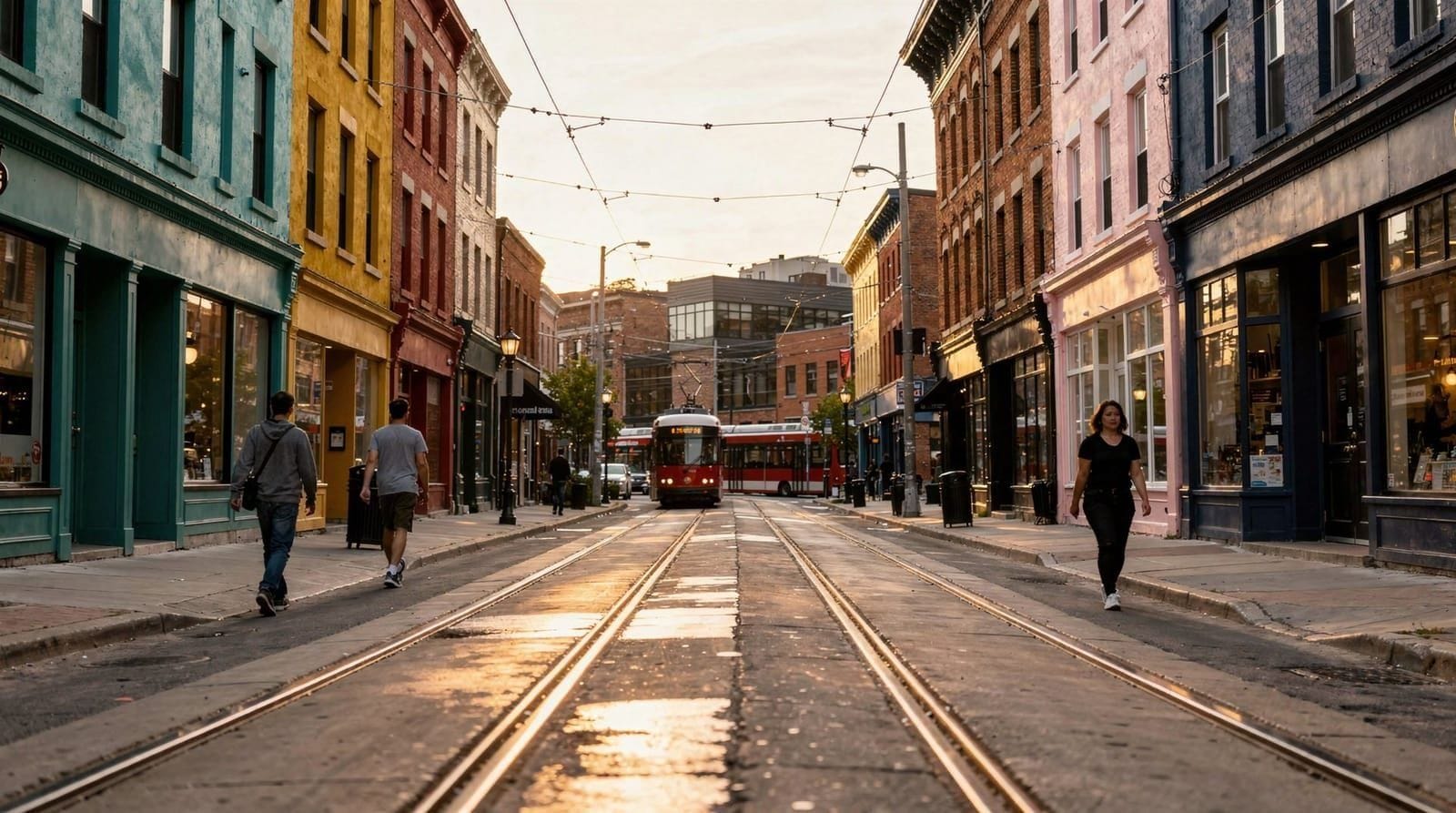
Toronto actually has several Chinatowns spread across the metro area — a larger, more suburban one in Markham and Scarborough serves the city’s substantial Chinese-Canadian population with a different, often more contemporary food scene. But the downtown Chinatown along Spadina Avenue, roughly between Dundas Street and College Street, is the historic original, dating back over a century, and it remains a genuinely active, unpolished commercial strip rather than a tourist-oriented reconstruction. Signage is still mostly in Chinese first, English second, grocers spill produce onto the sidewalk, and the restaurant turnover reflects real market pressure rather than curated tourism.
| Where | Spadina Avenue, between Dundas and College |
| Cost | Dim sum for two around CAD 25-45; noodles under CAD 15 |
| Time needed | 2-3 hours, longer if pairing with Kensington Market |
| Getting there | 510 Spadina streetcar or Dundas station |
| Best time | Any season; Lunar New Year (Jan/Feb) is liveliest |
What to eat, and how to choose
Chinatown’s density of restaurants means quality varies block to block, and the honest advice is to look for the places with a mostly Chinese clientele at lunchtime — a reliable, if imperfect, signal. Rol San on Spadina has been a dim sum institution for decades, known for long weekend waits that regulars consider part of the experience. Mother’s Dumplings, a few doors down, does exactly what the name promises with an open kitchen where you can watch dumplings being hand-folded. For something faster and cheaper, the neighbourhood’s bubble tea shops and bakery counters (egg tarts, pineapple buns) make for a good wandering snack between stops rather than a sit-down meal.
Beyond Cantonese: the neighbourhood’s broader mix
While the historic core is predominantly Cantonese and southern Chinese in character, Chinatown’s restaurant mix has broadened over the decades to include Vietnamese, Malaysian, and other Southeast Asian cuisines, reflecting shifts in the neighbourhood’s business ownership and Toronto’s broader immigration patterns. A bowl of pho or a plate of Malaysian noodles sits comfortably alongside the dim sum houses without feeling out of place — this layering is part of what distinguishes downtown Chinatown from a single-cuisine tourist district.
Markets and grocery browsing
Even if you’re not cooking, Chinatown’s grocery stores are worth a browse for the sheer density of unfamiliar produce, dried goods, and housewares packed into narrow aisles. Tap Phong Trading Co. and similar shops sell everything from woks to specialty teas at prices well below what you’d find in a curated gift shop elsewhere in the city. It’s an easy, free way to spend twenty minutes between meals.
Where Chinatown meets Kensington Market
Chinatown’s eastern edge blurs directly into Kensington Market without a hard boundary — Spadina Avenue itself is often considered the loose dividing line, though the two neighbourhoods’ characters overlap for a block or two on either side. Most visitors cover both in a single outing.
A Kensington Market and Chinatown two-hour tour is built specifically to cover both in one structured walk, useful if you’re short on time and want a guide’s read on where one neighbourhood’s character actually starts fading into the next. The Kensington and Chinatown hidden gems walk takes a similar route with more focus on smaller, easy-to-miss spots.
The neighbourhood’s earlier location
Toronto’s Chinatown wasn’t always centred on Spadina Avenue. An earlier Chinatown had developed around Elizabeth Street and York Street, close to where Nathan Phillips Square and the current City Hall now stand — that entire district was demolished in the 1950s and 60s as part of a large urban renewal project to build the new City Hall, displacing the community west to its current Spadina location. It’s a piece of the neighbourhood’s history that doesn’t show up in a typical guidebook stop, but it explains why the current Chinatown, despite feeling long-established, is technically the second iteration of the community’s downtown presence rather than a continuous, unbroken location since the earliest Chinese-Canadian settlement in the city.
Grocery browsing in more detail
Beyond Tap Phong, several other grocers along Spadina Avenue and Dundas Street West specialize in specific niches — one might carry an unusually deep selection of dried mushrooms and Chinese medicinal herbs, another a wall of imported snacks and instant noodles from across East and Southeast Asia. None of this requires a purchase to enjoy; simply walking the aisles of two or three different shops gives a better sense of the range of Chinatown’s food culture than any single restaurant meal could.
Lunar New Year
If your visit lines up with Lunar New Year (typically late January or February, date varies by the lunar calendar), Chinatown is at its most vivid — lion dances move down Spadina Avenue, storefronts are strung with red lanterns and decorations, and the restaurants run at full capacity with special menus. It’s worth checking the exact date before booking a trip if this is a priority, since it shifts year to year.
Getting there
The 510 Spadina streetcar runs directly through the neighbourhood’s core, and Dundas station on Line 1 sits a short walk east. Given the neighbourhood’s compact size — the main strip is only a handful of blocks — walking from either Kensington Market or the edge of downtown is entirely reasonable and often faster than waiting for transit.
Driving isn’t recommended given how limited and expensive street parking gets in the area, particularly on weekend evenings — the streetcar or a short walk from a nearby neighbourhood is genuinely the more practical option for most visitors.
A first-timer’s ordering strategy
If you’ve never done a sit-down dim sum meal, the easiest approach is to order two or three carts’ worth of whatever looks appealing as they pass your table rather than trying to read a full menu — this is how most regulars actually order, and it avoids the overwhelm of a printed dim sum list. Sharing dishes family-style across a table of two to four people gets the best variety for the price; a solo diner is better served by a noodle or rice counter than a full cart-service restaurant, where the format assumes a group.
Best time to visit
Chinatown works in any season since most of the activity is indoor dining and shopping, unlike a park- or waterfront-dependent neighbourhood. Weekday lunches offer shorter waits at the popular dim sum spots; weekends, particularly for dim sum, mean real queues at the best-known restaurants. Late evenings have their own appeal — several restaurants stay open past midnight, making Chinatown one of the more reliable options in the city for a meal after a show or a night out elsewhere.
Herbal medicine and specialty shops
Alongside the food and grocery scene, Chinatown retains a handful of traditional Chinese medicine shops selling dried herbs, ginseng, and remedies rooted in practices centuries older than the neighbourhood itself. These aren’t tourist curiosities — they serve a genuine local clientele — but browsing one respectfully, without expecting staff to explain every product in detail, gives a sense of the neighbourhood’s depth beyond restaurants and produce stalls.
Bubble tea and dessert culture
Alongside the savoury food scene, Chinatown’s bubble tea shops and dessert parlours have become destinations in their own right for a younger crowd, with several offering house-made toppings and flavours not found at the chain bubble tea shops that have since spread across the wider city. This is a good lower-cost, lower-commitment way to sample the neighbourhood if a full sit-down meal doesn’t fit your schedule — a drink and a walk covers a reasonable slice of the Chinatown experience in twenty minutes.
A sample evening visit
Chinatown works particularly well as a late-afternoon-into-evening stop, since several restaurants stay open past most of the city’s dinner-service cutoffs. Arrive around 5pm to avoid both the lunch and peak dinner crowds, browse a grocer or two while deciding where to eat, then settle in for dim sum or a noodle dinner before continuing on to Queen West or back toward downtown for a nightcap if the evening’s still young.
Practical tips
Cash is still commonly used at smaller grocers and some restaurants, though card acceptance has expanded significantly in recent years — worth carrying some cash as a backup regardless. Portions at most Chinatown restaurants run generous and prices stay noticeably lower than equivalent quality elsewhere downtown, making this one of the better neighbourhoods in the city for a cheap, filling meal. If you’re set on a specific dim sum spot on a weekend, arrive right at opening or expect a wait.
Chinatown’s role in the city’s broader immigration story
Toronto’s downtown Chinatown developed against a backdrop of significant historical discrimination — Canada’s Chinese Immigration Act (in effect from 1923 to 1947, following decades of earlier restrictive head taxes) severely limited Chinese immigration for over two decades, and the community that built and sustained the Spadina Avenue Chinatown did so despite considerable legal and social barriers most visitors today aren’t aware of. This history adds real weight to what might otherwise read as simply a good place to eat — the neighbourhood’s continued vibrancy reflects generations of resilience against policy specifically designed to prevent exactly this kind of community from taking root.
Combining Chinatown with a broader west-end itinerary
Chinatown’s compact size makes it easy to underestimate how much time to allocate — most visitors budget too little, expecting a quick walk-through, and end up wanting to stay longer once they start actually eating and browsing. If you’re combining it with Kensington Market and Queen West in a single day, consider anchoring Chinatown as your dinner stop rather than a midday pass-through, since the neighbourhood’s later restaurant hours suit an evening visit better than the market’s more daytime-oriented rhythm.
Practical price expectations
A full sit-down dim sum meal for two typically runs C$25-45 depending on how many dishes you order, noticeably below equivalent quality elsewhere downtown. A quick noodle or rice dish at a casual counter often comes in under C$15, making Chinatown one of the more reliably budget-friendly dining neighbourhoods in the core for visitors managing a tighter daily food budget without sacrificing quality.
A note on managing your appetite
Given how easy it is to graze continuously through Chinatown’s density of food options, it’s worth pacing yourself deliberately if you’re planning to eat elsewhere afterward — a full dim sum meal followed by bubble tea and a bakery stop adds up quickly, and many visitors end up skipping their planned dinner elsewhere simply because Chinatown filled them up first.
Chinatown versus Little Italy for an evening out
Visitors deciding between neighbourhoods for a food-focused evening sometimes weigh Chinatown against Little Italy further west along College Street. Chinatown offers denser, cheaper, later-running options with real browsing value across dozens of restaurants and grocers; Little Italy leans toward a slower, patio-driven Italian and café scene with fewer but more date-night-oriented spots. Both work well on their own, and combining the two in a single night means a streetcar ride rather than a walk, so pick one as the anchor rather than trying to rush both.
Comparing Chinatown restaurants to elsewhere in the city
Given the recent expansion of good Chinese and pan-Asian dining across other Toronto neighbourhoods, some visitors question whether downtown Chinatown remains the best place to eat this cuisine in the city. The honest answer is nuanced: newer restaurants elsewhere sometimes match or exceed Chinatown’s food quality individually, but nowhere else offers the same density and browsing experience of dozens of options within a few compact blocks, which remains the neighbourhood’s real, enduring advantage.
Frequently asked questions about Chinatown
Is downtown Chinatown the same as Markham’s Chinatown?
No, they’re different areas. Downtown Chinatown along Spadina Avenue is the older, historic core; Markham and Scarborough in the Greater Toronto Area have a larger, more contemporary Chinese-Canadian commercial and residential presence.
How do I get to Chinatown from downtown?
The 510 Spadina streetcar runs directly through it, or it’s a walkable 15-20 minutes from Union Station via Kensington Market.
Is Chinatown safe to visit?
Yes, it’s a busy, well-trafficked commercial district that stays active well into the evening, with standard city precautions applying as anywhere else.
What’s the best dish to try in Chinatown?
Dim sum is the signature experience, best at a sit-down restaurant like Rol San on a weekend morning; hand-folded dumplings and egg tarts are reliable, lower-commitment options if you’re wandering rather than sitting down for a full meal.
Do I need cash in Chinatown?
Card acceptance is now common, but some smaller grocers and food stalls still prefer or require cash, so it’s worth carrying a small amount as backup.
Can I combine Chinatown and Kensington Market in one visit?
Yes, easily — the two neighbourhoods border each other directly and most visitors cover both in a single two-to-three-hour outing. The Chinatown food guide and Kensington Market food guide both cover the shared border area in more depth if food is the priority.
Top experiences
Bookable activities with verified prices and instant confirmation on GetYourGuide.