Yorkville
Yorkville guide: Toronto's upscale shopping and museum district, home to the ROM, the AGO nearby, and the city's most expensive real estate per square
Royal Ontario Museum Admission Ticket
Quick facts
- Best base for
- Museums, upscale shopping, quiet streets
- Nearest subway
- Bay or Bloor-Yonge (Line 1/2)
- Signature sight
- Royal Ontario Museum's crystal facade
- Character
- 1960s hippie enclave turned luxury district
Yorkville packs two of Toronto’s biggest museums, its most exclusive shopping strip, and some of the city’s quietest downtown-adjacent streets into a compact, entirely walkable pocket north of Bloor Street. Most visitors treat it as a half-day add-on to a museum visit rather than a standalone destination, and that’s the right instinct — it rewards a focused few hours more than a sprawling itinerary.
| Where | North of Bloor St, between Yonge St and Avenue Rd |
| Time needed | Half a day for one museum, a full day for both ROM and AGO |
| Cost | Free to walk; ROM/AGO admission around C$25-30 each |
| Getting there | Bay or Bloor-Yonge subway station (Line 1/2), 5-min walk |
| Best time | Weekday afternoons for fewer crowds; Wednesday evenings for free AGO admission |
From hippie enclave to luxury district
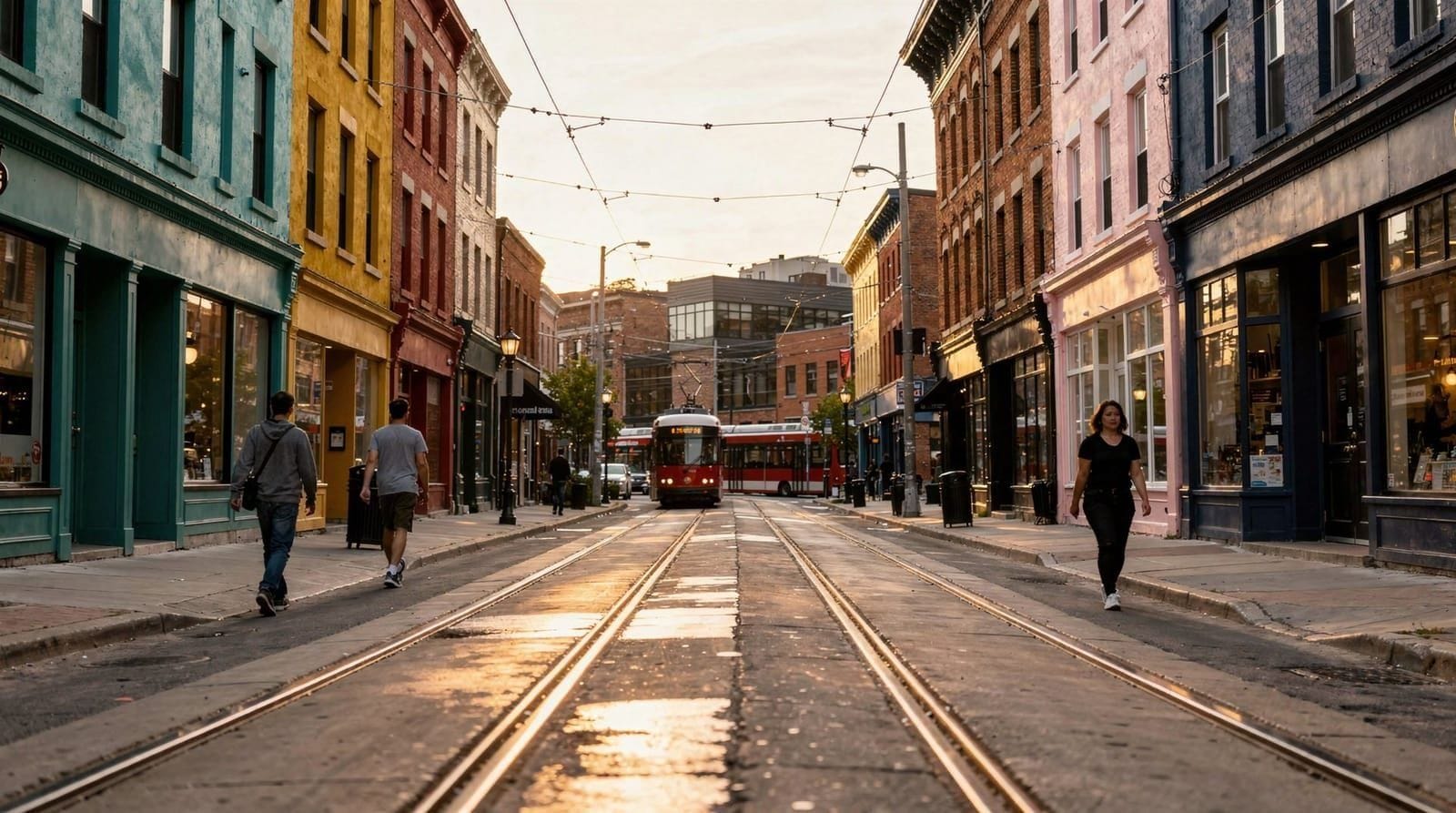
Yorkville’s reputation today — designer boutiques, valet parking, restaurant patios where a coffee costs more than a Kensington Market lunch — is almost the opposite of its 1960s identity as Toronto’s countercultural hub, when coffeehouses along Yorkville Avenue hosted a young Joni Mitchell and Neil Young. Rising rents pushed that scene out by the 1970s, and the neighbourhood spent the following decades reinventing itself as the city’s most expensive shopping district. Bloor Street between Yonge and Avenue Road, sometimes called the “Mink Mile,” now carries flagship stores for Cartier, Chanel, and Louis Vuitton. Walking it costs nothing, and even without a shopping budget, the streetscape and people-watching are worth the detour.
The Royal Ontario Museum
The ROM anchors Yorkville’s cultural identity, and its 2007 Michael Lee-Chin Crystal addition — an angular glass-and-aluminum structure that erupts out of the original 1914 heritage building — remains one of the most divisive pieces of architecture in the city. Locals either love it as a bold statement or still call it an eyesore two decades on; either way, it photographs distinctively. Inside, the collection spans dinosaur fossils, a genuinely strong Egyptian and East Asian art collection, and rotating special exhibitions that draw international attention.
General admission runs roughly C$28-30 for adults, and the museum offers free entry on the third Tuesday of most months (excluding some peak periods) — check current dates before planning around it. A straightforward ROM admission ticket lets you skip the ticket line at the door, while a ROM guided history tour is worth the upgrade if you want the collection’s highlights contextualized rather than self-navigated — the museum is large enough that an unguided first visit can feel overwhelming.
The Art Gallery of Ontario, a short walk south
The AGO sits technically outside Yorkville proper, closer to Queen West and Chinatown, but it’s close enough (about a 15-minute walk or short transit ride) that most visitors pair the two museums in a single day. The AGO holds over 90,000 works, with particular strength in Canadian art (including the largest public collection of Group of Seven paintings) alongside European masters and a Frank Gehry-redesigned building that’s worth seeing on its own terms.
It’s free for visitors 25 and under year-round and offers free general admission Wednesday evenings — a detail that changes the calculus on when to visit considerably. A AGO general admission ticket covers the permanent collection; special exhibitions typically cost extra.
Shopping without the price tag
Yorkville’s boutiques aren’t the only reason to walk it. Hazelton Lanes and the Yorkville Village complex mix high-end retail with more accessible dining options, and the neighbourhood’s side streets — genuinely quiet, tree-lined, lined with converted Victorian houses now housing galleries and small offices — offer a version of central Toronto that feels almost residential compared to the density a few blocks south. Cumberland Street and the small Yorkville Park (built on the former site of a rock quarry, with a section featuring an enormous relocated granite boulder) are worth a slow walk even if you’re not buying anything.
Where to eat
Yorkville leans upscale by default, but not exclusively. Sassafraz on Cumberland Street has been a see-and-be-seen spot for decades, particularly during the Toronto International Film Festival when the neighbourhood’s proximity to premiere venues draws a heavier celebrity presence than usual. For something more casual, the food hall inside Hazelton Lanes and several coffee shops along Yorkville Avenue offer a lower-cost way to experience the neighbourhood without a full restaurant tab.
Yorkville during TIFF
Yorkville’s proximity to several Toronto International Film Festival premiere venues means the neighbourhood takes on a noticeably different character every September — increased security presence around certain hotels, a higher chance of a genuine celebrity sighting outside Sassafraz or one of the boutique hotels along Yorkville Avenue, and restaurant reservations that become considerably harder to secure without booking well ahead. If TIFF isn’t your priority, this is worth knowing as a reason to either lean into the energy or plan your Yorkville visit for a different week entirely.
The underground parking lot that made history
Yorkville Village (formerly the Manulife Centre complex area) sits above what was, at the time of its construction, one of the more ambitious underground developments in the city — a detail that matters less for the parking itself than for understanding how thoroughly Yorkville has been rebuilt and reinvested in over the decades since its 1960s bohemian period. Cumberland Street’s redevelopment through the 1990s and 2000s formalized much of the pedestrian-friendly streetscape visitors see today, including the small parkette spaces that break up the retail frontage.
A lower-budget way to experience Yorkville
If the shopping and fine dining are outside your budget, Yorkville still rewards a visit: Yorkville Park’s granite boulder and landscaped sections cost nothing, window-shopping the Mink Mile is free, and the area’s side streets offer some of the best free architecture-viewing in the city, courtesy of the converted Victorian houses now serving as galleries and small offices. Pair a free walk here with a Wednesday evening at the AGO for a genuinely low-cost but high-value Yorkville afternoon.
Yorkville versus Toronto’s other shopping and culture districts
Visitors deciding where to spend a limited shopping or culture afternoon often weigh Yorkville against Queen West and the Distillery District. Each does something different, and picking the right one depends on what you actually want out of the afternoon.
| District | Best for | Price level | Vibe |
|---|---|---|---|
| Yorkville | Museums (ROM, AGO), designer flagships | High | Polished, quiet, upscale |
| Queen West | Independent boutiques, streetwear, galleries | Mid | Eclectic, walkable, younger crowd |
| Distillery District | Cobblestone atmosphere, artisan shops, cafes | Mid-high | Historic, pedestrian-only, photogenic |
If designer labels and a serious museum collection are the priority, Yorkville wins outright. If the goal is browsing independent shops and people-watching on a livelier strip, Queen West suits better, and if atmosphere and photography matter more than shopping, the Distillery District is the stronger pick.
Yorkville’s smaller galleries and dealers
Beyond the ROM and AGO, Yorkville’s side streets host a cluster of private art dealers and small commercial galleries — many tucked into converted Victorian houses on Hazelton Avenue and Scollard Street — that don’t show up on most visitors’ radar. These aren’t free-admission public institutions like the museums, but browsing is generally welcome and costs nothing. Serious collectors sometimes plan a visit specifically around a gallery opening, but even a casual walk-through on an afternoon when nothing is scheduled offers a look at contemporary Canadian and international work in a setting far less crowded than either flagship museum.
Getting there and around
Bay and Bloor-Yonge subway stations (Line 1 and Line 2) both sit within a five-minute walk of Yorkville’s core, making it one of the more transit-accessible upscale neighbourhoods in the city. Given the concentration of museums and shopping, the neighbourhood is very walkable once you’re there — most of what matters sits within a compact several-block radius bounded roughly by Bloor Street, Avenue Road, and Yonge Street.
Best time to visit
The museums make Yorkville a strong year-round destination, unlike outdoor-focused neighbourhoods that lose their appeal in winter. September through June covers the ROM and AGO’s full programming calendar, including major touring exhibitions. Summer sees the neighbourhood’s patios at their busiest, particularly during TIFF in September when Yorkville’s proximity to premiere venues brings extra energy (and higher restaurant prices) to the area.
Yorkville hotels for a special-occasion stay
Yorkville is home to some of the city’s most established luxury hotels, catering to a clientele that includes visiting film industry figures during TIFF and a steady stream of business travellers year-round. Staying here costs a genuine premium over downtown proper, but puts you within walking distance of both major museums and the Mink Mile, which suits visitors prioritizing a slower, more concentrated few days over covering the widest possible spread of neighbourhoods.
A combined museum day
For visitors specifically prioritizing culture over shopping, a full day pairing the ROM in the morning (arriving at opening to beat tour groups) with the AGO in the afternoon is a well-worn, reliable itinerary. Break for lunch somewhere between the two — the university-adjacent stretch near Casa Loma and The Annex offers more affordable options than staying within Yorkville’s core for the midday meal.
Practical tips
If museum-hopping, check both the ROM and AGO’s free or discounted admission windows before booking, since combining a free evening with a paid morning visit can meaningfully cut costs across a two-museum day. Yorkville restaurants generally require reservations on weekends, more so than equivalent spots in less formal neighbourhoods. If you’re visiting purely to window-shop and people-watch, a weekday afternoon avoids both the museum crowds and the weekend retail rush.
The Toronto International Festival of Authors and other cultural programming
Beyond its two flagship museums, Yorkville’s cultural calendar includes smaller, less-touristed events worth knowing about if your visit lines up — literary readings, gallery openings along the neighbourhood’s smaller side-street art spaces, and periodic classical and jazz performances tied to nearby venues. None draw the crowds of the ROM or AGO’s headline exhibitions, but they offer a quieter, more local way to experience the neighbourhood’s cultural identity beyond the two big institutions most visitors default to.
How Yorkville fits into a broader Toronto itinerary
For a multi-day visit, Yorkville works best as a half-day or full-day stop rather than a base for exploring the wider city, given its distance from more budget-friendly dining and its lack of the walkable variety you’d get from downtown or the west end. Pairing it with Casa Loma and The Annex — both reachable via Line 2 — makes for a natural culture-and-architecture day that avoids duplicating ground covered in a more central, retail-and-food-focused itinerary through Queen West or Kensington Market.
Special exhibitions and planning ahead
Both the ROM and AGO regularly host major touring exhibitions that draw significant crowds and often require timed-entry tickets purchased well in advance, separate from standard general admission. If a specific touring show is the reason for your visit, check ticket availability before finalizing travel dates, since the most popular exhibitions have been known to sell out entirely during their Toronto run, particularly on weekends.
Getting oriented without a car
Because Yorkville, the ROM, and the AGO all sit within a relatively compact area connected by subway and short walks, this is one of the easier parts of the city to navigate purely on foot and transit once you understand the basic layout — Bloor Street as the main east-west spine, with the museums and shopping clustered a few blocks in either direction from the Bay-Bloor intersection.
A final word on pacing
Given the density of things to see in a small area, it’s easy to overpack a Yorkville day and end up rushing through the ROM or AGO’s larger collections. If both museums are on your list, consider splitting them across two visits rather than one long day — the quality of attention you bring to a large collection drops noticeably after a couple of hours, and Yorkville rewards a slower, more deliberate pace over a checklist approach.
Frequently asked questions about Yorkville
Is Yorkville worth visiting if I’m not shopping?
Yes — the ROM and AGO alone justify a visit, and the neighbourhood’s quiet side streets and architecture are pleasant to walk regardless of budget.
How much does ROM admission cost?
Roughly C$28-30 for adults as a baseline, with discounts for students, seniors, and children, plus free admission on the third Tuesday of most months.
Can I walk between the ROM and the AGO?
Yes, it’s about a 15-20 minute walk, or a short subway and streetcar combination if you’d rather not walk both directions in one day.
What was Yorkville known for in the 1960s?
It was Toronto’s countercultural hub, home to coffeehouses and a folk music scene that included a young Joni Mitchell and Neil Young, before rising rents pushed that scene out by the 1970s.
Is Yorkville expensive to visit?
Shopping and fine dining there are genuinely expensive, but walking the neighbourhood, visiting Yorkville Park, and window-shopping cost nothing — the museums are the main paid expense for most visitors.
What’s the nearest subway station to Yorkville?
Bay station (Line 2) and Bloor-Yonge station (Line 1/2 interchange) both sit within a five-minute walk of the neighbourhood’s core.
Should I visit Yorkville or Queen West if I only have time for one?
It depends on your priority: Yorkville suits museum-goers and anyone wanting a quieter, upscale atmosphere, while Queen West offers more variety in independent shops, food, and a livelier street scene for a similar amount of walking.
Is Yorkville a good base for staying overnight?
It works well for visitors prioritizing a slower, museum-and-shopping-focused stay, but it costs a genuine premium over downtown and has fewer budget dining options nearby, so it suits shorter, special-occasion stays better than an extended budget-conscious trip.
Top experiences
Bookable activities with verified prices and instant confirmation on GetYourGuide.