Fall foliage in Algonquin Park
Algonquin Park Hiking: Adventure Tour from Toronto
When is peak fall foliage in Algonquin Park?
Peak colour typically hits in the last week of September through the first week of October, though the exact window shifts by several days year to year depending on temperature and rainfall. This is also the single busiest stretch of the year in the park, with full parking lots along the Highway 60 corridor and lines at both gates on weekends.
Why this particular week draws more visitors than any other in the park’s calendar
Algonquin Provincial Park sees more day-trippers in the last week of September and first week of October than at any other point in the year, and the reason is straightforward: the mix of sugar maple, red maple, and yellow birch along the Highway 60 corridor produces one of the most reliable and dramatic fall colour displays in Ontario.
Unlike a single showcase tree or garden, Algonquin’s display is landscape-scale — entire ridgelines and lake shores turning orange, red, and gold at once, viewed from lookout trails that climb just high enough to put the whole scene in frame. It’s also, unavoidably, the least convenient week to visit if solitude is part of the appeal, since word of the display has spread widely enough that gate lines and full parking lots are now a predictable feature of the season rather than an occasional inconvenience.
| Where | Highway 60 corridor, West Gate near Huntsville to East Gate near Whitney |
| Cost | ~21 CAD day-use vehicle permit; 60-120 CAD/person for a full day incl. gas |
| Time needed | 4-5 hours in the park after a 2.5-3 hr drive each way |
| Getting there | Self-drive from Toronto (~300 km) or a guided day tour with transport |
| Best time | Weekday mornings in the last week of Sept-first week of Oct, before 9am |
When the colour actually peaks
Peak colour in Algonquin typically falls in the last week of September through the first week of October, though this window moves by several days from year to year depending on temperature and rainfall through late summer. A cooler, wetter September tends to bring the peak forward; a warm, dry stretch delays it and can mute the intensity of reds in particular.
Because the shift is only a matter of days rather than weeks, it’s worth checking a current park foliage report shortly before your trip rather than locking in a date months in advance based on a general rule of thumb. The colour doesn’t switch on and off uniformly either — higher elevations and more exposed ridgelines tend to turn first, while sheltered valleys and areas closer to lakes lag by several days, which means a visit slightly before or after the stated “peak” can still deliver a strong display if you target the right pocket of the park.
The viewpoints worth the drive
Almost everything a day visitor can reach sits along the 56-kilometre Highway 60 corridor between the West Gate, closer to Huntsville, and the East Gate, closer to Whitney. 5-kilometre round trip climbing to a former fire tower site, delivers the single best panoramic view in the corridor and is worth the two-and-a-half to three hours it takes if you have the time. For a lower-effort option, the Hardwood Lookout Trail covers only about 800 metres but still reaches a genuinely rewarding vantage point over a colourful valley, making it the better choice on a tight schedule or with kids in tow.
The Algonquin Visitor Centre, perched on a ridge partway along the corridor, has a deck overlooking a wetland valley that turns particularly well and works as a no-hiking option paired with lunch at the on-site café. Several roadside pullouts scattered along Highway 60 also offer wide lake and forest views directly from the car, useful for a quick stop between trailheads.
Guided options exist for visitors who’d rather not navigate the drive and gate lines themselves. The Algonquin Park hiking adventure tour from Toronto builds a full day around the park’s trail network with transport included, which removes both the roughly five hours of round-trip driving and the stress of finding parking during the peak week — a meaningful advantage on the busiest weekends, when full lots at the popular trailheads can force a change of plans on the spot.
Handling the crowds
Peak week traffic is real and worth planning around rather than dismissing. Weekday visits see dramatically thinner crowds than weekends — a Tuesday or Wednesday during peak week often has the same colour with a fraction of the parking-lot competition. If a weekend is the only option, arrive before 9 a.m.; the most photographed pullouts and trailheads near the West Gate fill by mid-morning and stay full until mid-afternoon.
Buying a day-use vehicle permit online in advance is worth doing during this stretch specifically, since gate lines at both the East and West Gates can back up on the busiest Saturdays. Canoe rentals at the popular put-in points along Highway 60 also sell out by mid-morning on peak weekends, so reserving ahead matters if paddling a lake ringed in colour is part of the plan.
What a one-day foliage trip realistically covers
Given the roughly 300-kilometre, two-and-a-half to three-hour drive from downtown Toronto to the West Gate, plan to arrive by late morning and leave by mid-afternoon to be back at a reasonable hour, which leaves four to five hours inside the park. A realistic itinerary pairs one substantial trail — the Track and Tower Trail if time allows, the Hardwood Lookout if it doesn’t — with a stop at the Visitor Centre for lunch and a shorter second walk or a stretch of paddling if time and rental availability allow. Trying to fit in multiple long trails on top of the drive tends to produce a rushed day rather than an enjoyable one; the drive itself already consumes close to five hours round trip.
Budget for a fall foliage day trip
A day-use vehicle permit runs around 21 CAD, and canoe rentals at popular put-ins typically cost 30 to 45 CAD per hour. Factor in gas for the roughly 600-kilometre round trip and a modest lunch at the Visitor Centre café or packed from Toronto, and a self-driven day lands somewhere between 60 and 120 CAD per person depending on group size and how much you rent. A guided day trip that folds in transport and a set itinerary tends to run higher per person but removes the driving, gate-line uncertainty, and parking-lot competition that define the peak week specifically.
Comparing Algonquin’s foliage to Muskoka’s
Algonquin and Muskoka both peak in the same general window — the last week of September into the first week of October — but deliver different versions of fall. Algonquin’s forest is more continuous and its lookout trails climb higher, producing sweeping views over largely undeveloped land; Muskoka pairs its colour with lakes, resort towns, and considerably easier logistics, since the drive is shorter and the roads better serviced. For a full side-by-side of which suits a given trip better, see the fall foliage in Muskoka guide and the dedicated Muskoka vs. Algonquin comparison, which covers logistics, cost, and crowd levels for both.
Wildlife during fall
Fall brings a secondary draw beyond the colour itself: the moose rut, which typically runs through late September and into October, roughly overlapping with peak foliage. Bulls become more vocal and visible during this period as they compete for mates, and while sightings are never guaranteed on a single day trip, dawn and dusk drives along Highway 60 during rut season offer better odds than the late-spring roadside-salt window most visitors associate with moose watching. Black bears are also more active in fall, feeding heavily ahead of winter, though they tend to stay away from the busier roadside corridor and are far more commonly encountered by backcountry canoeists than day-trippers on foot near the highway.
Photographing the display well
The strongest light for photographing Algonquin’s fall colour comes in the first two hours after sunrise and the last two before sunset, when low-angle light brings out the reds and oranges more vividly than the flatter light of midday. A polarizing filter cuts glare off wet leaves and lake surfaces, which matters more here than at almost any other time of year given how much of the display sits reflected in water.
The Track and Tower Trail’s summit view works particularly well in morning light looking east, while lake-level shots at pullouts along Highway 60 tend to hold their colour better in the softer light of late afternoon. Weekday mornings combine the best light with the thinnest crowds, making an early-departure weekday trip the strongest option for anyone prioritizing photography over convenience.
Quieter alternatives to the busiest pullouts
The handful of postcard viewpoints closest to the West Gate — the ones featured in most photos of the park — draw the heaviest crowds precisely because they’re the easiest to reach. Trails and pullouts further along the corridor toward the East Gate, or the Mizzy Lake Trail loop slightly off the main road, see noticeably fewer visitors while offering comparable colour, since the maple and birch mix that produces the display isn’t concentrated only near the West Gate. Visitors willing to drive an extra 20 to 30 minutes further into the corridor before stopping tend to find both better parking availability and a quieter experience of the same forest.
How Algonquin compares to other Ontario fall foliage spots
Beyond Muskoka, a handful of other Ontario regions offer worthwhile fall colour without matching Algonquin’s scale — the Bruce Peninsula, Haliburton Highlands, and the Niagara Escarpment near Collingwood all turn in the same general late-September window. None offers quite the combination of continuous forest, elevation, and accessible lookout trails that Algonquin’s Highway 60 corridor does, which is part of why it remains the default answer for a Toronto-based fall colour day trip despite being the longest drive of the region’s classic day trips.
Fall colour from a canoe
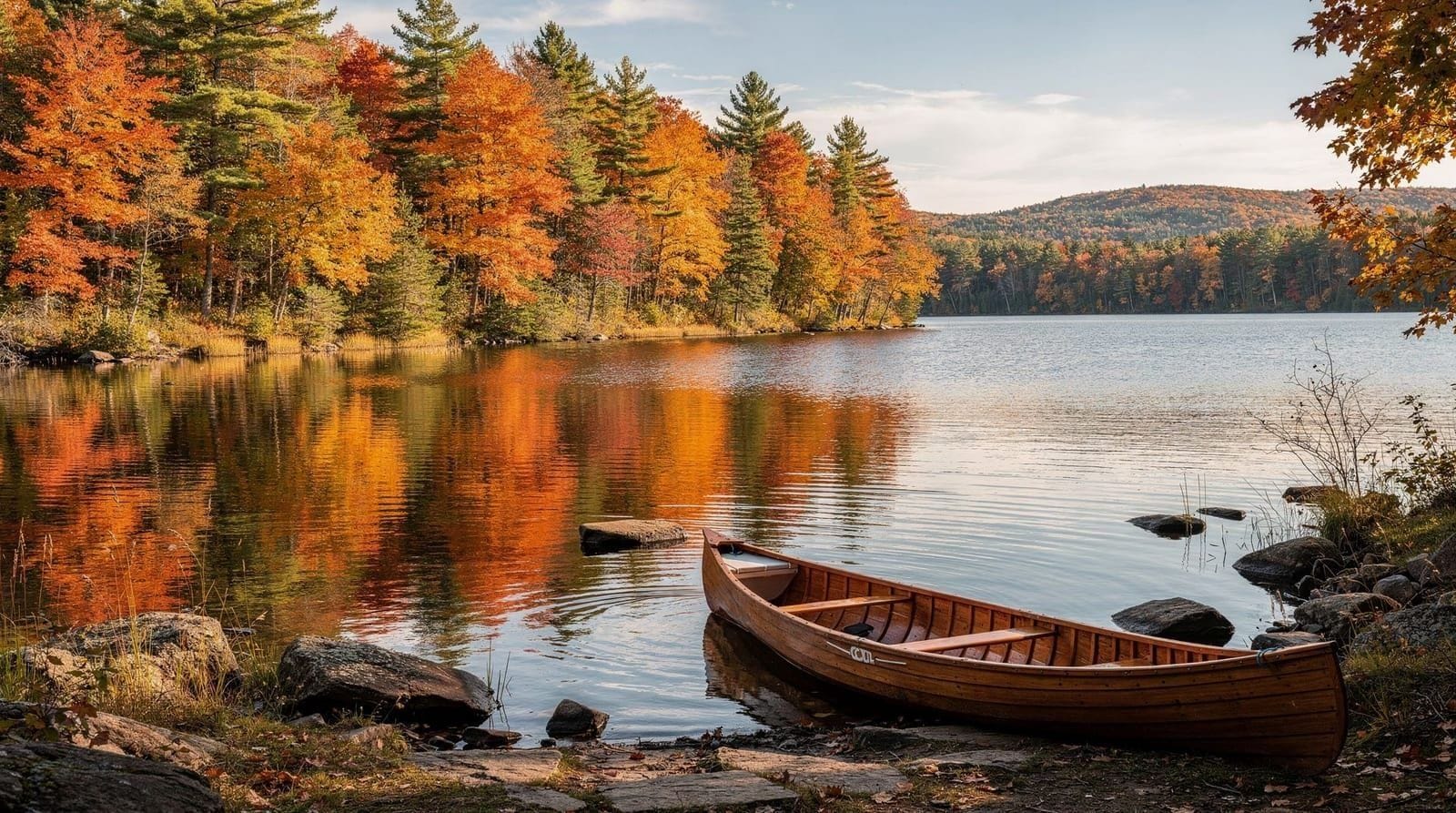
For visitors with the time and canoe experience, paddling one of the accessible lakes along Highway 60 during fall adds a water-level view of the colour that the roadside trails can’t match, with reflections doubling the display on a calm morning. Canoe Lake and the put-ins near the Portage Store are the most accessible for a short paddle without a backcountry permit, and even a single hour on the water gives a genuinely different sense of the forest than viewing it from a lookout trail. Renting at these put-ins during peak week is worth doing early in the day, since the limited fleet of rental canoes sells out by mid-morning on the busiest fall weekends, well before the trailhead parking lots themselves fill up.
Practical notes for a fall visit
Temperatures inside the park run several degrees cooler than Toronto even during a mild fall stretch, particularly near water and in shaded forest sections, so layering matters even on a day that starts warm. Fuel up before Huntsville, since gas stations thin out along Highway 60 itself. Cell service is unreliable to nonexistent past the West Gate, so download offline maps in advance.
Weekday visits, an early departure from Toronto, and a foliage report checked within a few days of travel are the three adjustments that do the most to improve a fall trip here relative to showing up unprepared during the single busiest stretch of the park’s year. For a broader look at the park outside foliage season, see things to do in Algonquin Park and the Algonquin Park day trip from Toronto guide for full logistics beyond the fall window.
Frequently asked questions about fall foliage in Algonquin Park
What’s the single best trail for photographing fall colour?
The Track and Tower Trail delivers the most complete panoramic view in the Highway 60 corridor, climbing to a former fire tower site with a wide outlook over the surrounding forest and lakes. For a shorter option with a still-strong payoff, the Hardwood Lookout Trail covers under a kilometre and reaches a genuinely photogenic vantage point.
How crowded does the park get during peak week?
Very crowded on weekends specifically — expect full parking lots at popular trailheads by mid-morning and gate lines at both the East and West Gates. Weekdays during the same window see meaningfully thinner crowds while the colour remains just as strong.
Should I stay overnight instead of doing a day trip during peak foliage?
An overnight stay near Huntsville or inside the park removes the roughly five hours of round-trip driving from a single day and allows an early-morning start on the trails before the day-tripper crowds arrive. It also opens up dawn and dusk wildlife viewing, which a single midday visit largely misses.
Does the foliage look different depending on where in the park I go?
Yes. Higher elevations and exposed ridgelines along the corridor tend to turn first, while low-lying areas near lakes and in sheltered valleys lag behind by several days. Visiting slightly before or after the stated park-wide “peak” can still produce excellent colour if you target the right pocket.
Is fall foliage season the same weekends as Thanksgiving weekend in Canada?
Canadian Thanksgiving usually falls close to or just after the tail end of peak colour, and the long weekend it creates is one of the single busiest of the year in the park as a result. If avoiding the largest crowds is a priority, a weekday visit the week before Thanksgiving weekend is generally the better bet.
Top experiences
Bookable activities with verified prices and instant confirmation on GetYourGuide.