Guide to St. Lawrence Market
Toronto: Private Food Discovery at St Lawrence Market
Why is St. Lawrence Market famous?
St. Lawrence Market, operating in some form since 1803, was named the world's best food market by National Geographic in 2012. It's a two-building historic complex housing dozens of independent food vendors, anchored by the peameal bacon sandwich, and it runs a large Saturday farmers market plus a Sunday antique market.
Two centuries of continuous market history
St. Lawrence Market has operated on this site, in some form, since 1803 — making it one of the oldest continuously running markets in North America. The current South Market building dates to 1845 and later incorporated Toronto’s original city hall into its structure, which is why the ground floor still shows off ornate 19th-century architectural details that most modern food halls can’t fake. In 2012, National Geographic named it the world’s best food market, a title the city still leans on heavily in tourism marketing, but one that holds up reasonably well on an actual visit — the vendor density and quality are genuinely high, not just well-marketed.
| Where | Front and Jarvis Streets, 10 min walk from Union Station |
| Cost | Free entry; around $15–25 CAD per person for a grazing lunch |
| Time needed | About 1 hour focused, closer to 2 hours on Saturday with the farmers market |
| Best day | Saturday for the farmers market, weekday afternoons for fewer crowds |
| Closed | Mondays |
Unlike a lot of “historic market” attractions that have drifted toward tourist-only souvenir stalls, St. Lawrence Market still functions as a working neighborhood market. Locals do real grocery shopping here, particularly on Saturdays, and that ongoing local use keeps quality and pricing more honest than a purely visitor-driven food hall would be.
The South Market building
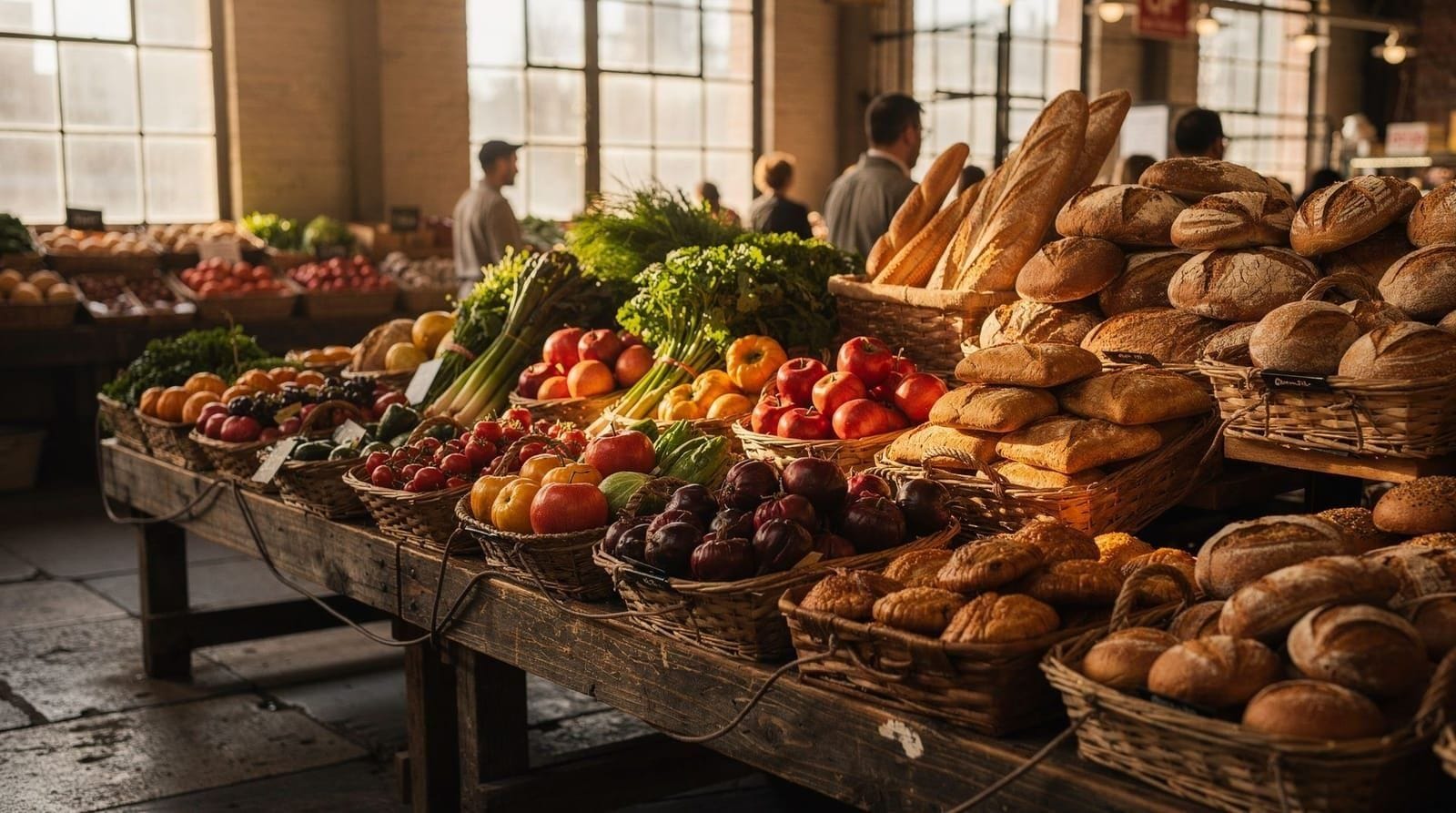
This is the market’s main hall, home to around 50 vendors under one roof — butchers, fishmongers, cheese shops, bakeries, and a long row of prepared-food counters. The single most famous stop is Carousel Bakery, whose peameal bacon sandwich has become the market’s unofficial signature dish: cured, unsmoked pork loin rolled in cornmeal, grilled to order, and served simply on a bun with mustard. It’s a genuinely Toronto-specific food — peameal bacon (sometimes called “Canadian bacon” internationally, confusingly) isn’t a dish you’ll find with the same prominence elsewhere.
Beyond the bacon sandwich, the South Market rewards grazing rather than committing to one stall — a cheese sample here, fresh oysters there, a pastry to finish. Prices run mid-range for Toronto: expect $9-11 CAD ($7-8 USD) for the peameal sandwich and similar for most other prepared-food portions. Compare it against the newer indoor options in our Toronto food halls guide if you want a sense of how the market stacks up against the city’s more recent food-hall openings.
Getting the full picture with a guide
The market’s history and its vendors’ individual stories — which stall has been run by the same family for three generations, which cheese counter sources from a specific Ontario farm — aren’t always obvious just wandering the aisles, and this is one of the better stops on our broader Toronto food tours guide if you want to compare guided options citywide. The private food discovery tour at St. Lawrence Market walks a small group through several vendors with a guide who provides that context and tastings along the way, useful if you want a curated introduction rather than figuring out where to start on your own.
Saturday farmers market
The North Market building, across the street from the main South Market, hosts an expanded farmers market every Saturday — Ontario producers selling fresh produce, meat, honey, and baked goods directly, a noticeably different crowd and pace than the South Market’s grab-and-go food stalls. It’s the best day to visit if you want to see the market at its most local and least tourist-oriented, though it’s also the busiest day overall.
Sunday antique market
On Sundays, the North Market building flips entirely into an antique and vintage market, with dozens of dealers selling furniture, jewelry, vinyl records, and general estate-sale finds. It has essentially nothing to do with the food market and draws a different visitor entirely — worth knowing if you show up on a Sunday expecting the Saturday farmers market and find something completely different instead.
When the market is closed or different
The market is closed on Mondays, which surprises visitors who show up expecting standard daily hours. Tuesday through Friday, the South Market runs its regular vendor hours with a mellower, more local crowd than the weekend. Checking the current day-by-day schedule before planning your visit matters more here than at most Toronto attractions, since the experience genuinely changes by day.
Getting there
St. Lawrence Market sits at the corner of Front and Jarvis Streets, about a 10-minute walk east from Union Station along Front Street — an easy add-on if you’re already downtown. The 504 King streetcar also stops nearby at Jarvis Street. There’s no dedicated market parking lot; nearby paid lots exist but fill quickly on Saturday mornings, and driving in for a Saturday visit specifically is one of the less convenient options given the crowds and parking competition.
Pairing it with the rest of your visit
St. Lawrence Market sits within easy walking distance of the Distillery District (about 15 minutes southeast), making the two a natural half-day combination, and the walk between them passes through the quieter Corktown area. It’s also close enough to the Financial District and Union Station to fold into a broader downtown walking route, covered in our downtown Toronto walking guide.
For a deeper dive specifically into the market’s food — vendor-by-vendor recommendations, what to skip, and how it compares to the newer food-hall concepts elsewhere in the city — see our St. Lawrence Market food guide. And if brunch is more your speed than a market crawl, our best brunch spots in Toronto guide covers sit-down alternatives nearby.
The 1849 fire and two centuries of rebuilding
St. Lawrence Market’s history is really a story of repeated destruction and rebuilding on the same footprint. An earlier market building on this site burned in the Great Fire of Toronto in April 1849, a blaze that destroyed a large swath of the city’s downtown core, including a city hall building that had stood on part of the market property. Rather than relocating, the city rebuilt directly on the same ground, and the market has occupied this exact corner of Front and Jarvis Streets continuously since — one of the longest unbroken market locations in North America.
The current South Market building, completed in 1902, actually incorporates walls and structural elements from an earlier city hall building into its lower levels — the outline of the old council chamber and some original stonework are still visible on the ground floor if you know where to look, tucked behind the modern vendor stalls. That layering of a 19th-century government building, an 1849 fire, and a 1902 market hall built partly atop the ruins is unusual even by Toronto standards, where relatively few structures from that era survived intact.
Many of the market’s current vendors have their own multi-generational histories layered on top of the building’s. Several of the butcher and cheese stalls have operated under the same family ownership for two, three, or in a few cases four generations, passing down not just the business but the accumulated relationships with Ontario farmers and producers that make a stall’s sourcing reliable. That continuity is part of why the market’s food quality has stayed consistent even as the surrounding city has changed dramatically — a fishmonger who has bought from the same suppliers for thirty years knows things about seasonal quality that a newly opened stall simply hasn’t had time to learn.
The market underwent its most recent major change in the 2020s, when the aging North Market building — built in 1968 and never particularly beloved architecturally — was demolished and replaced with a new, larger structure designed to house both the Saturday farmers market and expanded vendor space, while the historic 1902 South Market building was left untouched. The project ran long and over budget by local accounts, but it preserved the market’s most historically significant structure while finally giving the farmers market room to grow beyond its old, cramped footprint.
A short walk north of the market, St. Lawrence Hall is worth building into the same visit even though it’s a separate building. Completed in 1850 in the same rebuilding wave that followed the Great Fire, the hall served for decades as Toronto’s primary public meeting space and concert venue — the Swedish soprano Jenny Lind performed there in 1851 during her famous North American tour, and the building hosted a series of prominent anti-slavery meetings in the 1850s at a time when Toronto was a significant terminus of the Underground Railroad.
Its distinctive cupola and cast-iron balcony are still intact, and the building remains in use today for civic events and exhibitions rather than having been converted to retail. It sits directly across from the South Market building on Front Street, making it an easy add-on to a market visit.
Inside the South Market building itself, a lesser-known stop is the Market Gallery, a small municipal exhibition space on the second floor, in what was originally Toronto’s city council chamber before that function moved elsewhere. Operated by the City of Toronto’s museum services, it hosts rotating exhibitions drawing on the city’s historical archives — old maps, photographs, and civic artifacts — and admission is free.
Few visitors make it upstairs, since the ground-floor food stalls are the obvious draw and the gallery’s entrance isn’t heavily signed, but it’s a quiet break from the market’s crowds and one of the only places in the building where you can see the space’s original civic function rather than its current use as vendor stalls. It typically keeps shorter hours than the market itself, often closed on the same Mondays as the rest of the building and sometimes on an additional weekday, so checking the current schedule before making a special trip upstairs is worthwhile.
Practical notes
- Cost: No admission fee; you pay only for what you buy. A full lunch grazing through a few stalls runs $15-25 CAD ($11-18 USD) per person.
- Cash and cards: Most vendors take cards now, though a handful of smaller stalls still prefer cash — carrying some is a reasonable backup.
- Crowds: Saturday mornings are the busiest by a wide margin; weekday afternoons are notably calmer if you want to browse without waiting in line for the bacon sandwich.
- Accessibility: Both market buildings are wheelchair accessible with wide aisles, though the South Market gets tight during peak Saturday crowds.
St. Lawrence Market is one of the few Toronto attractions that genuinely lives up to its “world’s best” branding — the trick is knowing which day to show up on, since Tuesday and Saturday are close to two different markets entirely.
Which day should you actually visit?
| Day | What’s on | Crowds |
|---|---|---|
| Monday | Closed | — |
| Tuesday–Friday | Regular South Market vendor hours | Light to moderate |
| Saturday | South Market plus North Market farmers market | Heaviest of the week |
| Sunday | North Market switches to an antique and vintage market | Moderate, different crowd entirely |
If your priority is food and a calmer pace, a weekday afternoon is the honest answer — you’ll get the same vendors and the same peameal bacon sandwich with none of the Saturday queue. If seeing the market at its most local and lively matters more, Saturday morning is worth the crowds, especially if you arrive close to opening.
Vendors worth seeking out beyond the bacon sandwich
Beyond Carousel Bakery, a few South Market stalls are worth building a stop around specifically. The cheese counters carry a strong selection of Ontario and Quebec artisanal cheeses, several offering samples if you ask. The seafood vendors sell fresh oysters shucked to order, a reasonable mid-morning stop if you’re grazing rather than eating a full meal. A handful of the butcher stalls sell prepared, ready-to-cook items — sausages, marinated cuts — that make a good if unconventional souvenir for travelers with kitchen access later in their trip. Compare notes against the St. Lawrence Market food guide for a fuller stall-by-stall breakdown before you go.
Frequently asked questions about St. Lawrence Market
Is St. Lawrence Market open every day?
No. The main market building is closed on Mondays, runs regular vendor hours Tuesday through Friday, hosts an expanded farmers market on Saturday, and switches to an antique market on Sunday. Check current hours before visiting, since the schedule differs meaningfully by day.
What should I eat at St. Lawrence Market?
The peameal bacon sandwich from Carousel Bakery is the market’s signature dish — cured, unsmoked pork loin coated in cornmeal, grilled and served on a bun. Beyond that, the market has strong cheese, seafood, and baked-goods vendors worth grazing through rather than committing to one stall.
How do you get to St. Lawrence Market?
It’s about a 10-minute walk east from Union Station along Front Street, or a short ride on the 504 King streetcar to Jarvis Street. No dedicated parking lot exists on-site; nearby paid lots fill quickly on Saturdays.
Is St. Lawrence Market touristy?
It draws visitors, but it’s still a working market that locals use for weekly grocery shopping, particularly on Saturdays. That mix of tourist and local traffic is part of what keeps quality and prices in check compared to a purely tourist-oriented food hall.
How long should I spend at St. Lawrence Market?
An hour covers a focused visit to grab lunch and browse a few stalls. Saturday visitors combining the farmers market in the North Market building should budget closer to two hours.
Is St. Lawrence Market cheap?
It’s mid-range by Toronto standards — a peameal bacon sandwich runs about $9-11 CAD ($7-8 USD), and most prepared-food stalls fall in a similar range. It’s generally better value than downtown tourist-district restaurants for a comparable quality of ingredients.
Can I buy food to take home or cook later?
Yes — several butcher and produce stalls sell raw or prepared items suited to cooking, not just ready-to-eat food, which works well if you have kitchen access at your accommodation. Items like cheese and cured meats also travel reasonably well as souvenirs for the rest of a trip.
Is the Sunday antique market worth visiting even if I don’t collect antiques?
It’s still worth a browse even without buying anything — the mix of vintage furniture, jewelry, and estate-sale finds gives a different sense of the building than the food-focused South Market, and it’s free to walk through.
Top experiences
Bookable activities with verified prices and instant confirmation on GetYourGuide.