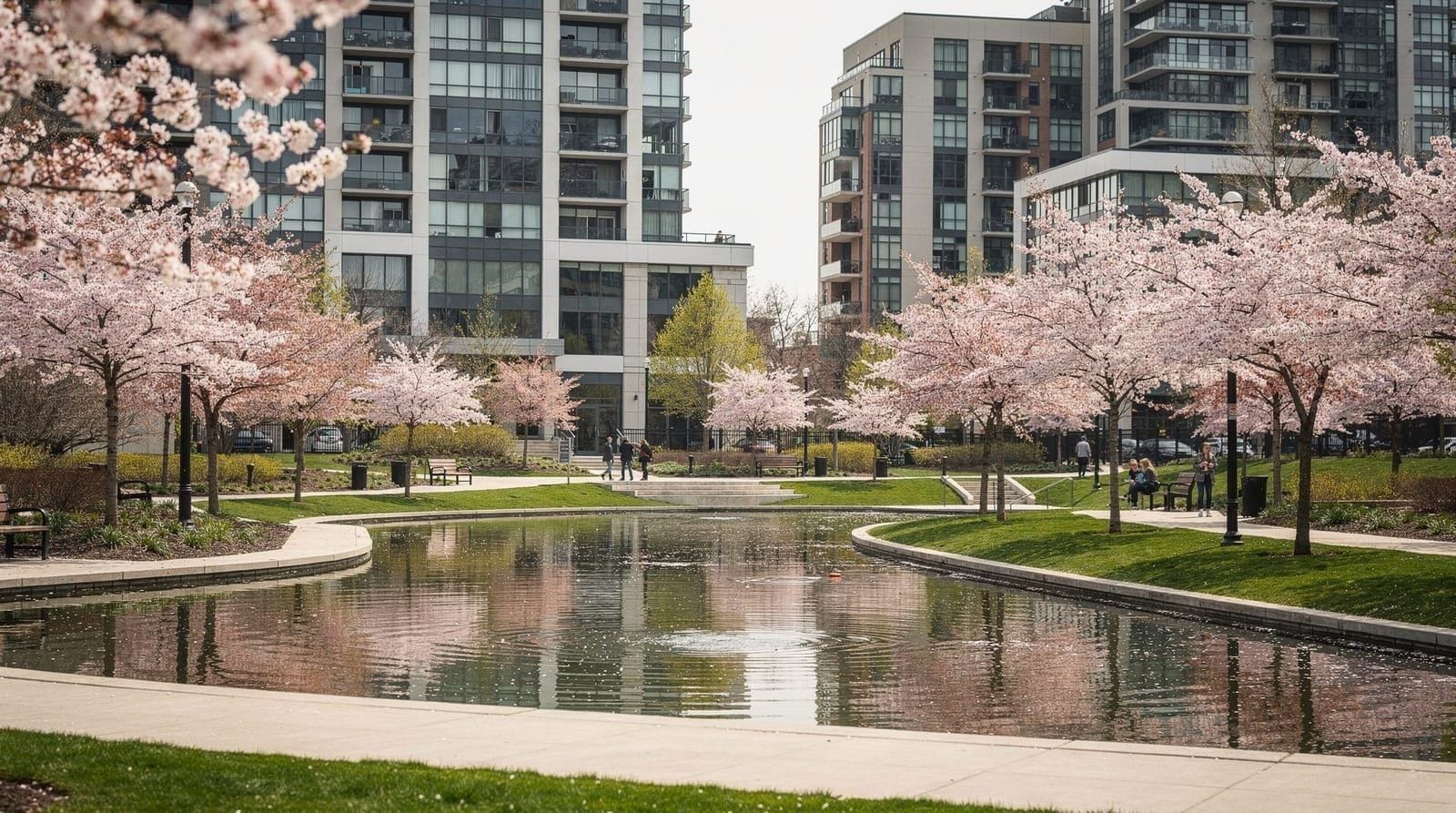
Mississauga
Mississauga travel guide: Port Credit waterfront, Square One, Celebration Square, and how to visit Ontario's third-largest city as a day trip.
Quick facts
- Distance from Toronto
- 25 km / 30-40 minutes by car or GO Train
- Population
- Ontario's third-largest city
- Best known for
- Port Credit waterfront, Square One, Absolute World (the 'Marilyn Monroe towers')
- Best time to visit
- June-September for the waterfront and patios
Toronto’s neighbor with its own skyline and waterfront
Mississauga sits directly west of Toronto along Lake Ontario, and while it’s often lumped in as “greater Toronto,” it’s Ontario’s third-largest city in its own right, with a downtown skyline distinctive enough that the twisting Absolute World towers — nicknamed the “Marilyn Monroe towers” for their curved silhouette — have become a minor architectural landmark. It’s rarely anyone’s primary reason to visit Ontario, but for travelers staying near Pearson Airport, working through a longer GTA itinerary, or simply curious about life outside Toronto’s downtown core, it rewards a half-day to full day visit.
The city’s two most distinct areas are its purpose-built downtown around Square One — dense, modern, mall-anchored — and Port Credit, a genuinely charming lakeside village on the Credit River that predates Mississauga’s amalgamation and still feels like its own small town. They’re different enough experiences that combining both gives a more complete picture of the city than either alone.
Mississauga’s rapid growth from farmland into Canada’s third-largest city happened almost entirely within living memory — much of the development that defines the city today occurred from the 1970s onward, following a formal amalgamation of smaller communities including Port Credit, Streetsville, and Cooksville. That relatively recent, planned growth explains both the modern feel of the downtown core and the persistence of older village character in pockets like Port Credit and Streetsville, which retained their own identities even as the surrounding area urbanized rapidly around them.
Getting there from Toronto
By GO Train: Mississauga is served by multiple GO lines, with stations connecting to both the downtown core (Square One area, via bus from Cooksville or Erindale stations) and Port Credit directly, which has its own GO station on the Lakeshore West line — arguably the easiest single stop for visitors focused on the waterfront.
By car: about 30–40 minutes from downtown Toronto via the QEW or Highway 401/403, and useful if you’re planning to see both Port Credit and the Square One area in one day, since they’re not within easy walking distance of each other.
Via MiWay transit: Mississauga’s local bus network connects the GO stations to Square One, Celebration Square, and other points across the city, workable for a car-free day focused on downtown Mississauga specifically.
What to actually do in Mississauga
Port Credit is the highlight for most visitors — a walkable lakeside village at the mouth of the Credit River, with a marina, a boardwalk trail along Lake Ontario, and a main street (Lakeshore Road) lined with independent restaurants and patios. It has a small-town feel that’s genuinely distinct from the density of downtown Mississauga a few kilometres north, and the waterfront trail connects further along the lake in both directions for a longer walk or bike ride.
Square One Shopping Centre, one of Canada’s largest malls, anchors downtown Mississauga and draws shoppers from across the GTA — over 360 stores, useful as a rainy-day option or for travelers specifically looking for retail therapy rather than sightseeing.
Celebration Square, adjacent to Square One and Mississauga’s City Hall, hosts free outdoor events, concerts, and a seasonal ice rink in winter — the closest thing the city has to a central civic gathering space, and worth a stop if there’s an event running during your visit.
Absolute World (the “Marilyn Monroe towers”), a pair of curved condo towers near Square One, has become an unofficial architectural landmark since completion — worth a photo stop even if you’re not otherwise drawn to the downtown core.
Bradley Museum and Benares Historic House, two preserved 19th-century homes near the lakeshore, offer a quieter counterpoint to the modern downtown, giving a sense of the area’s history before Mississauga’s rapid postwar growth.
Culinary diversity is one of Mississauga’s genuine strengths — the city’s population includes large South Asian, Chinese, Filipino, and Middle Eastern communities, and the restaurant scene reflects that far more than a typical suburban city, particularly along Dundas Street and in the Streetsville and Malton areas.
Streetsville, an older village absorbed into Mississauga’s boundaries decades ago, retains its own small historic Main Street with independent shops and restaurants — a lesser-known alternative to Port Credit’s waterfront charm, worth exploring if you’ve already covered the more obvious downtown and lakeside areas.
Riverwood Conservancy, a green space along the Credit River near the city’s centre, offers walking trails and historic estate grounds — a quieter nature stop distinct from the busier lakefront trail at Port Credit.
Where to eat in Mississauga
Port Credit’s Lakeshore Road is the most concentrated and visitor-friendly dining strip, with patios overlooking the marina and a genuine range from casual to upscale. For a deeper dive into the city’s culinary diversity, the Dundas Street corridor and the Streetsville and Malton neighborhoods carry some of the strongest South Asian, particularly Punjabi and Sri Lankan, dining in the GTA — worth a specific detour for food-focused travelers rather than assuming Port Credit alone represents the city’s food scene.
Square One’s food court and surrounding retail plazas offer a convenient, if less distinctive, option if you’re primarily there for shopping and want a quick meal without leaving the downtown core.
Streetsville’s smaller Main Street rounds out a third option, with a mix of casual cafés and family-run restaurants that lean less polished but often better value than Port Credit’s more waterfront-premium pricing.
Best time to visit
June through September is the strongest window, when Port Credit’s waterfront patios and boardwalk are at their best and Celebration Square’s outdoor event calendar is most active. Port Credit hosts its own summer waterfront festival, and the marina is at its liveliest with boat traffic.
Winter still has appeal at Celebration Square, which runs a seasonal outdoor ice rink and holiday lighting, but the Port Credit waterfront is considerably less inviting in the cold, and most of the outdoor draws (the boardwalk, patios) are diminished.
Practical tips
- Don’t try to see all of Mississauga in one trip — it’s a genuinely large, spread-out city, and Port Credit versus downtown Square One are different enough areas that picking one focus per visit works better than rushing between both.
- Port Credit parking fills up on summer weekends; the GO Train station directly serves the village and avoids the parking search entirely.
- Pearson Airport proximity makes Mississauga a practical stopover if you have a layover or an early flight — several airport hotels sit within Mississauga’s boundaries, closer to YYZ than most downtown Toronto options.
- MiWay day passes are worth it if you’re planning multiple stops across the city without a car.
- This isn’t a “must-see” Ontario destination in the way Niagara Falls or Muskoka are — it’s best framed as a worthwhile half-day for travelers with GTA time to spare, not a priority stop on a first Ontario trip.
- Check for events at Celebration Square before visiting — the free outdoor programming can make an otherwise unremarkable downtown stop genuinely worthwhile if the timing lines up.
Where this fits in a longer trip
Mississauga pairs naturally with other Greater Toronto Area destinations covered on this site, particularly Hamilton further west along Lake Ontario, and Markham or Richmond Hill on the opposite side of the GTA if you’re building a broader suburban-Toronto day. It’s also a practical stop for travelers flying in or out of Pearson Airport who want to fill a few hours without heading all the way into downtown Toronto.
For deeper Toronto planning, see our guides on Pearson Airport to downtown, useful if you’re weighing a Mississauga stopover against heading straight into the city, and best Toronto neighborhoods to stay for comparison against basing yourself in Mississauga instead. The GO Transit guide covers the train network connecting Mississauga to downtown Toronto and beyond in more detail.
Port Credit versus downtown Square One for a half-day
If you can only pick one side of the city, Port Credit is the stronger choice for most visitors — it’s walkable, has its own GO station, and delivers the small-town waterfront feel that Square One’s mall-anchored downtown doesn’t attempt to replicate. Square One is worth the trip specifically if shopping or an event at Celebration Square is the actual goal, or if you’re already downtown and want a rainy-day backup. Combining both in one day is realistic with a car, since they’re a 15-20 minute drive apart, but not easily done by transit alone in a single visit.
Frequently asked questions about Mississauga
Is Mississauga worth visiting as a separate trip from Toronto?
For most first-time Ontario visitors, no — it’s better treated as a half-day addition if you have GTA time to spare, a stopover near Pearson Airport, or a specific interest in Port Credit’s waterfront, rather than a priority destination on its own. It doesn’t have a single must-see attraction on the level of Niagara Falls or Toronto’s downtown core.
What’s the difference between Port Credit and downtown Mississauga?
Port Credit is a walkable lakeside village with a small-town feel, independent restaurants, and a marina, while downtown Mississauga around Square One is dense, modern, and mall-anchored, built around retail and condo towers rather than heritage character. They’re roughly 15–20 minutes apart by car and offer genuinely different experiences.
Can I get to Port Credit without a car?
Yes — Port Credit has its own GO Train station on the Lakeshore West line, making it one of the easiest car-free day trips in the GTA, with the village, waterfront, and boardwalk all within walking distance of the station.
Is Square One worth visiting if I’m not shopping?
Not particularly on its own, though the adjacent Celebration Square hosts free events and a winter ice rink worth checking if timing aligns, and the Absolute World towers nearby are a quick, free photo stop even without a mall visit planned.
How close is Mississauga to Pearson Airport?
Very close — much of Mississauga’s northern area borders Pearson Airport directly, and several airport hotels are technically within Mississauga’s city limits, making it a practical base for early flights or layovers rather than staying in downtown Toronto.
Is Mississauga safe for visitors?
Yes, Mississauga is generally considered a safe city with low crime rates typical of Ontario’s suburban municipalities. Standard urban precautions apply, particularly around transit stations at night, but there are no specific areas flagged as unsafe for typical daytime visitors.
What is Streetsville?
Streetsville is an older village that was absorbed into Mississauga’s municipal boundaries decades ago but retains its own distinct historic Main Street, independent shops, and restaurants — a quieter, less touristed alternative to Port Credit’s waterfront village atmosphere, appealing to visitors who want a similar small-town feel without the crowds.
Where is the best area for South Asian food in Mississauga?
The Dundas Street corridor along with the Streetsville and Malton neighborhoods carry some of the strongest South Asian dining in the city, reflecting the significant Punjabi, Sri Lankan, and broader South Asian communities established there. It’s a genuine destination for food-focused travelers specifically, distinct from the more general dining found in Port Credit or around Square One.