GO Transit guide
What is GO Transit and how does it work?
GO Transit is the Greater Toronto Area's regional train and bus network, connecting downtown Union Station to surrounding cities and day-trip destinations like Niagara Falls (1.5-2 hours) and Hamilton (45 minutes to an hour). Fares are distance-based, paid with a PRESTO card or contactless tap, and separate from TTC city transit fares.
The regional network that opens up Ontario day trips without a car
While the TTC covers Toronto proper, GO Transit is the regional system that connects the city to the wider Greater Toronto Area and several genuinely worthwhile day-trip destinations beyond it. If you’re planning to visit Niagara Falls, Hamilton, or Stratford without renting a car, GO Transit is very likely part of your plan — this guide covers how the system works, what it costs, and which of the region’s popular day trips it actually reaches.
| Where it goes | Niagara Falls, Hamilton, Kitchener-Waterloo, plus GTA suburbs |
| Cost | Around $12–25 CAD each way, distance-based via PRESTO |
| Time to Niagara | Roughly 1.5–2 hours by GO Bus Route 40 |
| Time to Hamilton | Roughly 45 minutes to an hour on the Lakeshore West line |
| Booking | Usually not needed; check capacity for summer weekends |
| Hub station | Union Station, downtown Toronto |
How GO Transit differs from the TTC
GO Transit and the TTC are separate systems with separate fare structures, even though a single PRESTO card works across both. TTC fares are flat-rate regardless of distance within the city; GO Transit fares are distance-based, meaning a short hop to a nearby GTA suburb costs less than a longer trip to Niagara Falls or Kitchener. Both trains and buses operate under the GO Transit brand, with trains running on dedicated rail lines radiating out from Union Station and buses covering routes and destinations the rail network doesn’t reach directly.
Paying for GO Transit: PRESTO and contactless
The same PRESTO card used on the TTC works on GO Transit, and it’s genuinely the easiest way to pay, since it calculates the correct distance-based fare automatically based on where you tap on and tap off. Contactless bank cards and phone tap-to-pay are also accepted on most routes, functioning the same way. Paper tickets are still available at station kiosks and vending machines for those without a compatible card, though they’re a slower, less convenient option than tapping.
Important: unlike the TTC’s flat fare, GO Transit requires you to tap both on boarding and off at your destination — missing the tap-off, particularly on trains, can result in being charged the maximum possible fare for that line rather than your actual distance traveled. Station platforms have PRESTO readers positioned clearly near the boarding area; get in the habit of tapping both directions.
GO Transit’s rail lines: what they connect
GO’s train network radiates from Union Station along several corridors. The Lakeshore West line runs toward Hamilton, taking roughly 45 minutes to an hour depending on the specific station and time of day — see the Hamilton waterfalls day trip for how this connects to Hamilton’s conservation areas once you arrive. The Kitchener line extends toward Guelph and Kitchener-Waterloo, useful as a partial connection toward Elora, though the final leg to Elora itself requires a local connection or taxi. Other lines serve Barrie, Stouffville, and Milton, primarily commuter-focused routes less relevant to typical visitor day trips.
GO Bus: covering routes the trains don’t
GO’s bus network fills gaps the rail lines don’t reach directly, and it’s the more relevant option for two of the region’s most popular day trips. Route 40 to Niagara Falls runs from Union Station (and several other GTA stations) directly to the Niagara Falls tourist area in roughly 1.5-2 hours, dropping you close to the falls and the WEGO shuttle network that covers the immediate Niagara Parkway attractions — see how to get to Niagara Falls from Toronto for the full breakdown of this specific route.
GO buses to Stratford connect via a Kitchener-line train transfer or a direct bus depending on current scheduling — check GO Transit’s trip planner for the current best routing, since bus connections to Stratford have shifted over the years as service patterns changed.
Frequency and scheduling
GO Transit’s frequency varies considerably by line and time of day — some corridors run every 15-30 minutes during weekday peak hours and considerably less often on weekends or off-peak, while others (including the Niagara Falls bus route) run on a more limited daily schedule that’s worth checking well before your planned travel date rather than assuming turn-up-and-go frequency. Use the GO Transit app or website’s trip planner to confirm current departure times for your specific route and date, since schedules do shift seasonally, particularly for the more tourist-oriented Niagara Falls service, which sometimes runs additional trips during peak summer season.
Booking ahead vs. buying at the station
Most GO Transit routes don’t require advance booking — tap your PRESTO card or buy a ticket at the station kiosk and board the next departure. The exception is during particularly high-demand periods (long weekends, major event days, or peak summer Saturdays on the Niagara Falls route), when it’s worth checking whether the specific trip you want has capacity, since buses in particular can sell out on the busiest days. See best day trips from Toronto by train for a broader comparison of which regional destinations work well by GO Transit versus VIA Rail versus requiring a car.
GO Transit stations in downtown Toronto
Union Station is the primary hub for virtually all GO Transit rail lines and most bus routes, located centrally downtown and well connected to the TTC subway, making it a genuinely convenient starting point regardless of where your downtown accommodation is located. A handful of GO bus routes also serve secondary pickup points elsewhere in the GTA, useful if your hotel happens to be closer to one of those than to Union Station itself.
What GO Transit doesn’t cover
It’s worth being clear-eyed about the network’s limits: Muskoka, Algonquin Provincial Park, Blue Mountain, and Prince Edward County have no direct GO Transit service, since these are genuinely car-dependent regions beyond the network’s Greater Toronto Area-focused coverage. For those destinations, see the renting a car in Ontario guide or consider a guided day tour with included transport as the practical alternative to self-driving.
What GO trains and buses are actually like
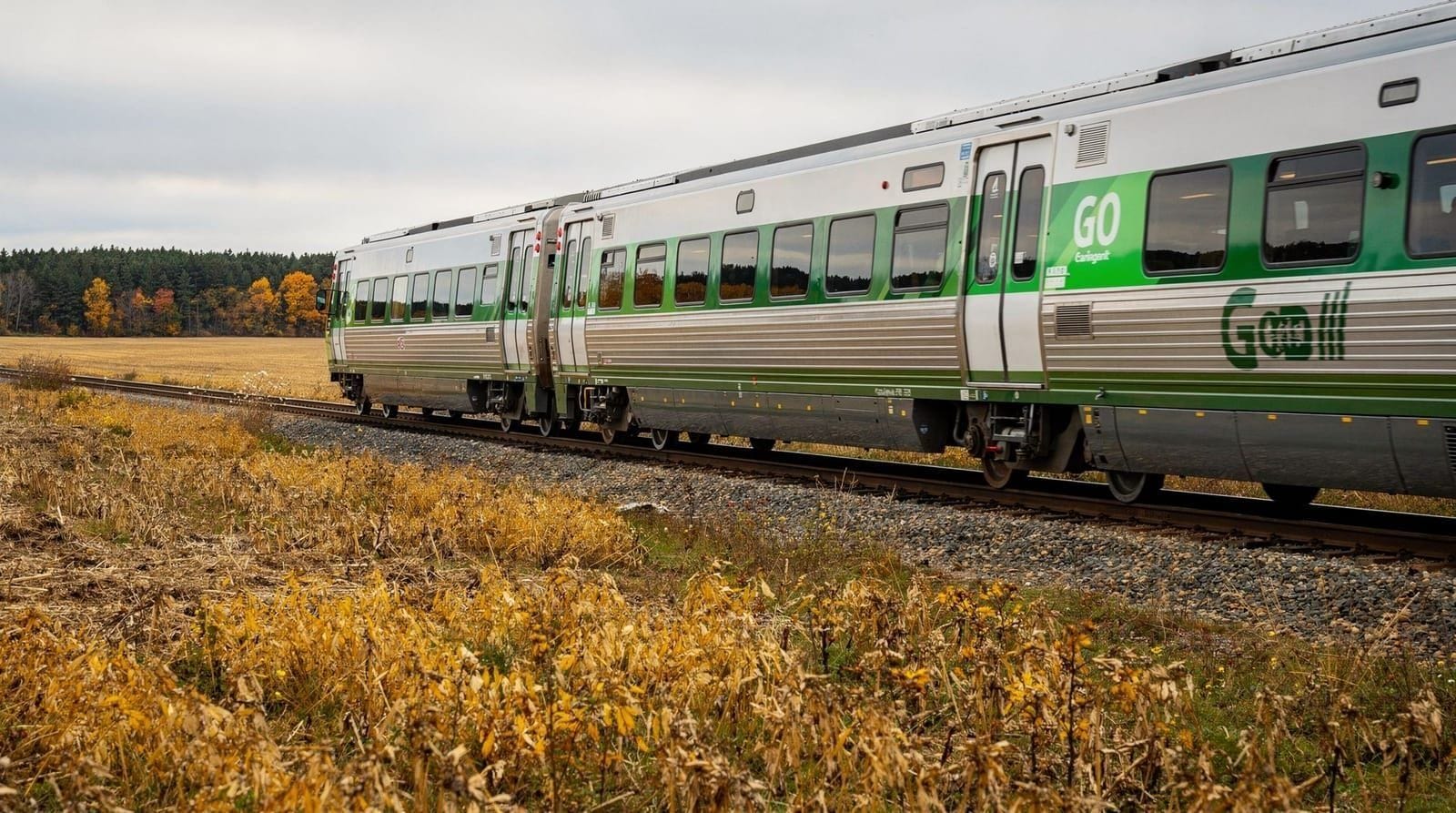
GO’s rail fleet runs primarily double-decker coaches, offering considerably more seating capacity and a generally more spacious, comfortable ride than a typical commuter train — genuinely pleasant for a day-trip journey rather than feeling like a cramped city transit vehicle. Trains have overhead luggage racks and enough room for day-trip bags, though they’re not designed for large suitcases the way VIA Rail’s longer-distance trains are. GO buses are standard motorcoach-style vehicles with overhead racks and, on longer routes like the Niagara Falls service, a more comfortable seating configuration than a typical city bus.
Accessibility on GO Transit
Most GO train stations and all GO buses are equipped for wheelchair accessibility, with level boarding available at accessible platform sections and ramps on buses. Some older or smaller stations have more limited accessibility features — check GO Transit’s website for station-specific accessibility details if this is a concern for your trip, particularly for less-traveled routes outside the main Lakeshore corridors.
Cost comparison: GO Transit vs. renting a car for day trips
For a single day trip to Niagara Falls or Hamilton, GO Transit fares (typically in the $12-25 CAD range each way depending on distance and whether you’re using PRESTO) are almost always cheaper than a rental car once you factor in daily rental cost, gas, parking at the destination, and Ontario’s toll highways on some routes. The calculation shifts if you’re traveling as a group of three or four splitting a rental car cost, or if your itinerary includes multiple car-dependent stops in a single day that GO Transit simply can’t reach — see the renting a car in Ontario guide for a fuller cost breakdown across different travel-party sizes.
Seasonal service changes worth knowing about
GO Transit occasionally adjusts service frequency and adds extra trips on popular seasonal routes — the Niagara Falls bus service in particular sometimes sees additional weekend departures added during peak summer months to handle higher demand, while some routes see reduced frequency in the depths of winter when day-trip travel drops off. Checking the current schedule close to your travel date, rather than relying on a schedule you looked up months in advance, is worth the extra few minutes given how much these seasonal adjustments can shift actual departure availability.
Combining GO Transit with VIA Rail for longer trips
For destinations beyond GO’s network — Kingston, Ottawa, or Montreal — VIA Rail takes over as the relevant long-distance option, departing from the same Union Station hub but operating as an entirely separate system with its own fares and booking process. See the VIA Rail Toronto guide for how the two systems complement each other for a longer Ontario itinerary that mixes regional GO day trips with longer VIA Rail excursions.
GO Transit vs. VIA Rail vs. driving: which to pick
| Option | Best for | Typical cost (one way) | Trade-off |
|---|---|---|---|
| GO Transit | Niagara Falls, Hamilton, Kitchener-Waterloo corridor | Around $12–25 CAD | Cheapest, but limited to GO’s fixed routes and schedules |
| VIA Rail | Kingston, Ottawa, Montreal | Higher, varies by fare class | Faster and more comfortable for longer distances GO doesn’t reach |
| Rental car | Muskoka, Algonquin, Blue Mountain, Prince Edward County | Daily rate plus gas, parking, tolls | Only realistic option for car-dependent regions; cheaper per-person in a group |
| Guided day tour | Niagara Falls, wine country, when you don’t want to plan transit at all | Varies by operator | Includes transport and often skip-the-line entry, but less flexible timing |
Tips for first-time GO Transit riders
If you’ve never used GO before, the biggest adjustment coming from the TTC is the tap-off requirement — build the habit early, since forgetting even once on a longer route like Niagara Falls can mean an unexpectedly large fare deduction. Download the GO Transit app before you travel; it shows live departure boards, platform assignments (which can change shortly before departure at busier stations), and lets you top up a digital PRESTO balance without hunting for a physical kiosk.
At Union Station specifically, GO’s platforms are a short walk from the TTC subway concourse but not immediately adjacent, so build in a few extra minutes if you’re transferring directly from a subway ride, especially with luggage. Seating on trains is unassigned and first-come, first-served, so arriving a few minutes before departure on popular routes gets you a better choice of seat, particularly on the double-decker cars where upper-level seating fills first on scenic routes like the Niagara run.
Weekday vs. weekend service differences
GO Transit’s weekday schedule is built around commuter demand, meaning some corridors run frequently during morning and evening peak windows and considerably less often mid-day. Weekends flip this pattern for tourist-relevant routes: the Niagara Falls bus service typically runs more consistently across the day on Saturdays and Sundays than it does on a weekday, since it’s built around day-trip demand rather than commuting. If you’re planning a weekday day trip to Niagara or Hamilton, double-check the schedule rather than assuming the same frequency you’d see on a Saturday — some weekday off-peak windows have noticeably longer gaps between departures.
Frequently asked questions about GO Transit
Is GO Transit the same as the TTC?
No — they’re separate systems with different fare structures (TTC is flat-rate, GO is distance-based), though a single PRESTO card works across both.
How do I pay for GO Transit?
Tap a PRESTO card or contactless bank card/phone both when boarding and when leaving your destination station — GO calculates your fare based on the distance traveled between those two taps.
Does GO Transit go to Niagara Falls?
Yes, via GO Bus Route 40 from Union Station, taking roughly 1.5-2 hours and dropping you close to the falls and the WEGO shuttle network.
Do I need to book GO Transit tickets in advance?
Generally no for most routes, though booking or checking capacity ahead is worth it for high-demand periods like summer weekends on the Niagara Falls route.
What happens if I forget to tap off on GO Transit?
You may be charged the maximum possible fare for that line rather than your actual distance traveled — always tap both when boarding and when exiting your destination station.
Which Ontario day trips can’t I reach by GO Transit?
Muskoka, Algonquin Provincial Park, Blue Mountain, and Prince Edward County have no direct GO Transit service and require a rental car or guided tour instead.
Is GO Transit cheaper than renting a car for a day trip?
For a solo traveler or couple, yes, in almost all cases once rental cost, gas, and parking are factored in. The calculation can favor a rental car for larger groups splitting the cost, or for itineraries covering multiple stops in a single day that GO Transit doesn’t reach.
Can I bring luggage on GO Transit?
Yes — trains and buses both have overhead racks suitable for day-trip bags and backpacks, though the system isn’t designed for large suitcases the way VIA Rail’s longer-distance service is.
Does GO Transit run less often on weekends?
It depends on the corridor — commuter-focused lines run less often on weekends, but tourist-relevant routes like the Niagara Falls bus often run more consistently across the day on Saturdays and Sundays than they do on weekday off-peak windows.
Can I use the same PRESTO card on GO Transit and the TTC?
Yes — one PRESTO card works across both systems, though GO Transit calculates a distance-based fare while the TTC charges a flat rate regardless of how far you travel within the city.