Best Toronto neighborhoods to stay
What is the best neighborhood to stay in Toronto?
Downtown, around Union Station and the Financial District, is the best all-around base for first-time visitors — it's walkable to the CN Tower, St. Lawrence Market, and the Distillery District, and it's the transit hub for reaching everywhere else. Yorkville suits luxury travelers, King West and Queen West suit nightlife-focused visitors, and the Beaches suits those prioritizing quiet over convenience.
There’s no single right answer — it depends what you’re optimizing for
Toronto doesn’t have one obviously correct neighborhood to base yourself in the way some cities do. The city’s major attractions are spread across a wide downtown footprint rather than clustered around one square, which means the “best” neighborhood really comes down to whether you’re optimizing for walkability, nightlife, quiet, budget, or a specific interest like shopping or art. Below is an honest comparison of the main contenders, without pretending any one is the universal answer.
| Neighborhood | Best for | Airport transit |
|---|---|---|
| Downtown core | First-time visitors, convenience | ~45-60 min (UP Express) |
| Yorkville | Luxury, museums, quiet evenings | ~60-75 min |
| Distillery District/Corktown | Atmosphere, couples | ~60-75 min |
| Queen West/King West | Nightlife, arts | ~60-70 min |
| Kensington Market/Annex | Budget, local character | ~75-90 min transit |
| The Beaches | Quiet, families, outdoor space | ~90+ min |
Downtown core (Financial District, Union Station area)
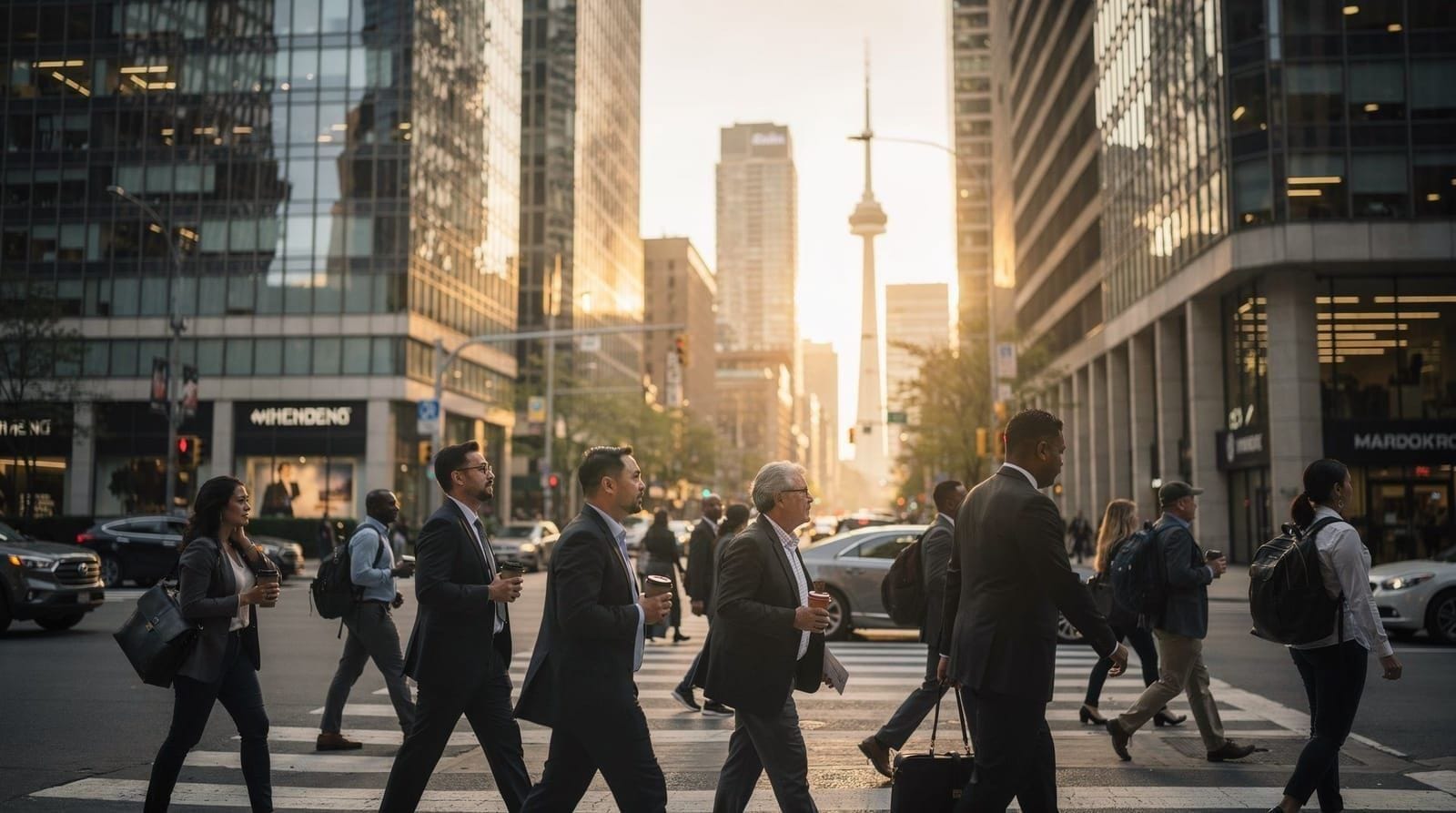
This is the default choice for first-time visitors, and for good reason: it puts you within walking distance of the CN Tower, the Financial District, St. Lawrence Market, and the Distillery District, and it’s the transit anchor for reaching everywhere else in the city via GO Transit, VIA Rail, and the subway. Hotels here run the full spectrum from budget chains to five-star properties, and the area is well-lit and busy at most hours.
The trade-off is character — the Financial District is a business district first, and it goes quiet on weekend evenings once office towers empty out. It’s also the most tourist-priced neighborhood in the city for food and drink. Best for: first-time visitors, business travelers, anyone prioritizing convenience and transit access over neighborhood atmosphere.
Yorkville
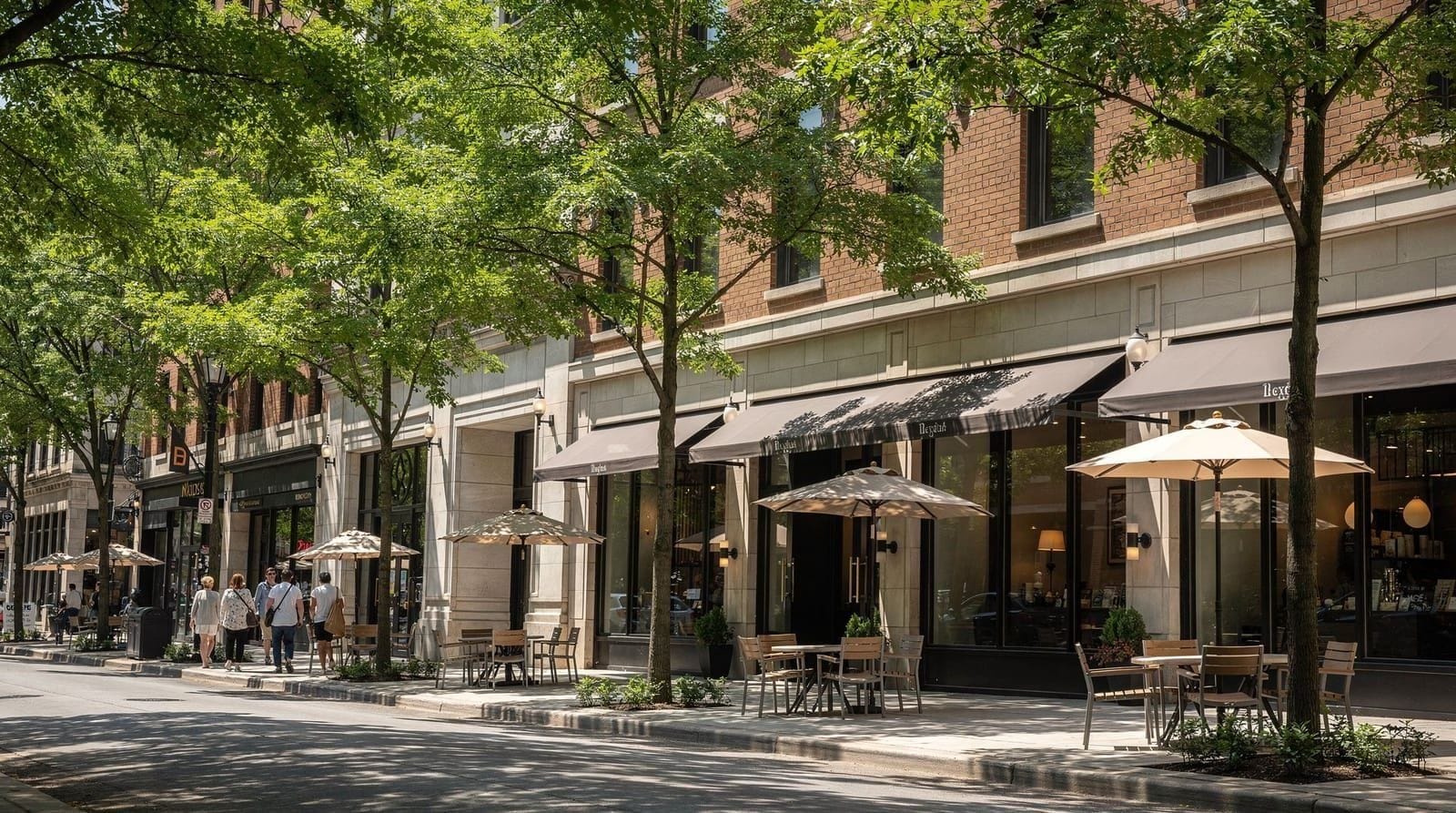
Toronto’s luxury hotel and shopping cluster, walkable to the Royal Ontario Museum and Art Gallery of Ontario, and noticeably quieter at night than downtown’s entertainment strips. Our guide to Yorkville covers the neighborhood’s shopping and museum access in depth. It sits a 20-25 minute walk (or a quick subway ride) north of the waterfront and CN Tower area, which is the main trade-off — you’re paying a premium for a specific kind of upscale calm rather than central proximity to the harbourfront. Best for: travelers prioritizing luxury accommodation, museum access, and a quieter evening scene.
Distillery District and Corktown
Staying near the Distillery District puts you in one of Toronto’s most photogenic, car-free historic neighborhoods, with easy access to St. Lawrence Market and the eastern waterfront. Our guide to the Distillery District covers the area’s shops, restaurants, and atmosphere. The hotel selection here is smaller and skews boutique rather than budget, and you’re a slightly longer walk (15-20 minutes) from the CN Tower and Financial District core than staying directly downtown. Best for: couples, design- and history-minded travelers, and anyone who prioritizes atmosphere over being dead-center.
Queen West and King West
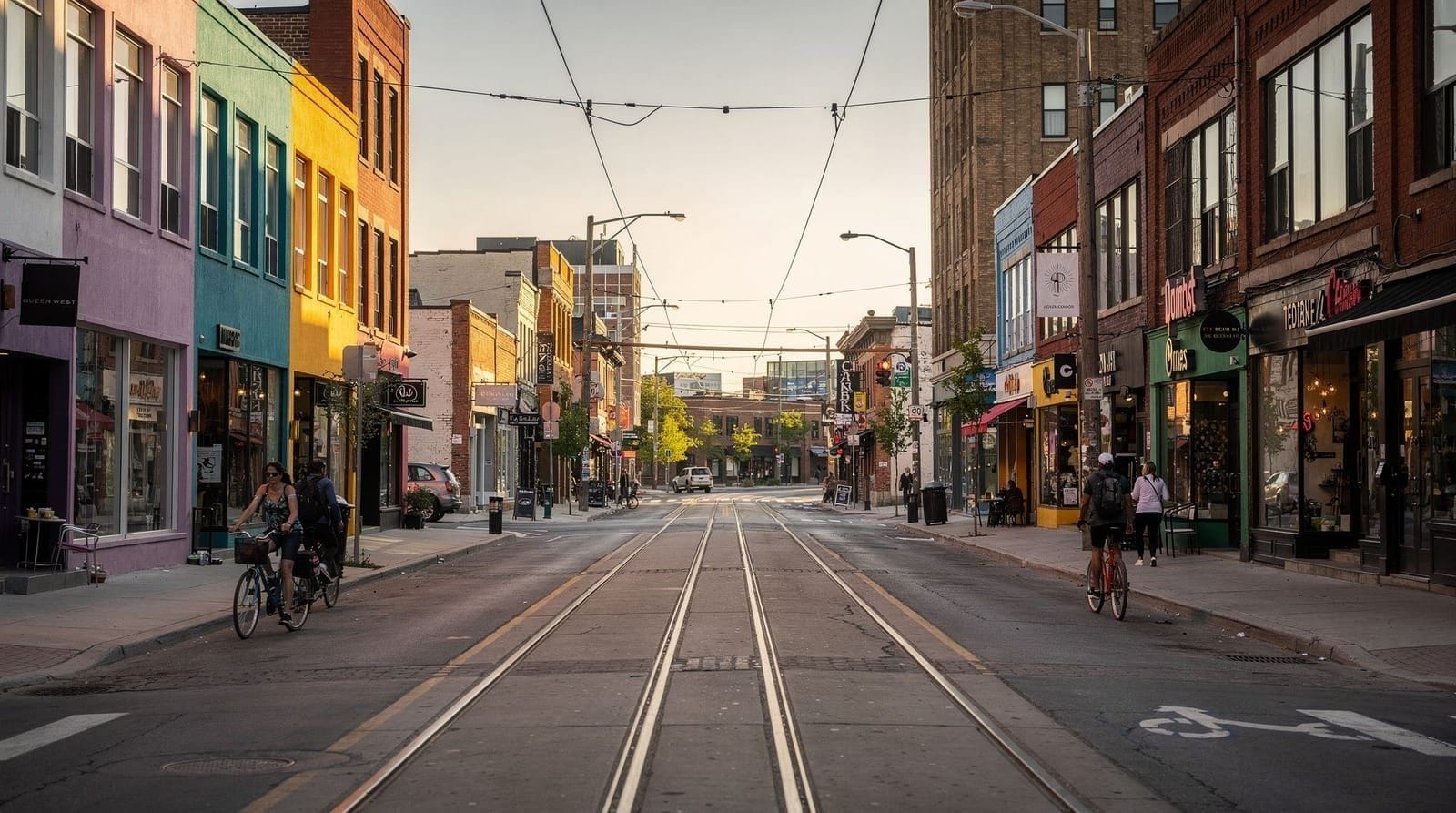
The nightlife and arts corridor, with the highest concentration of bars, restaurants, and independent galleries per block anywhere in the city. Our guide to Queen West covers the neighborhood’s Drake and Gladstone hotel scene alongside its broader character. It’s well-connected by streetcar to downtown but requires more transit time to reach the CN Tower and waterfront than staying directly in the core. Best for: nightlife-focused visitors, younger travelers, and anyone who wants a neighborhood with a strong identity of its own rather than a purely convenient hub.
Kensington Market and the Annex
Staying near Kensington Market or the adjacent Annex neighborhood typically means lower accommodation costs than downtown or Yorkville, along with genuine local character and easy access to the University of Toronto area, Chinatown, and Queen West. Our guide to Kensington Market covers the food and shopping scene in this stretch.
The trade-off is a 20-25 minute walk or a streetcar-plus-walk to reach the CN Tower and waterfront attractions, and hotel options are sparser — most visitors here use short-term rentals rather than branded hotels. Best for: budget-conscious travelers, longer stays, and anyone prioritizing neighborhood character over proximity to headline attractions.
The Beaches
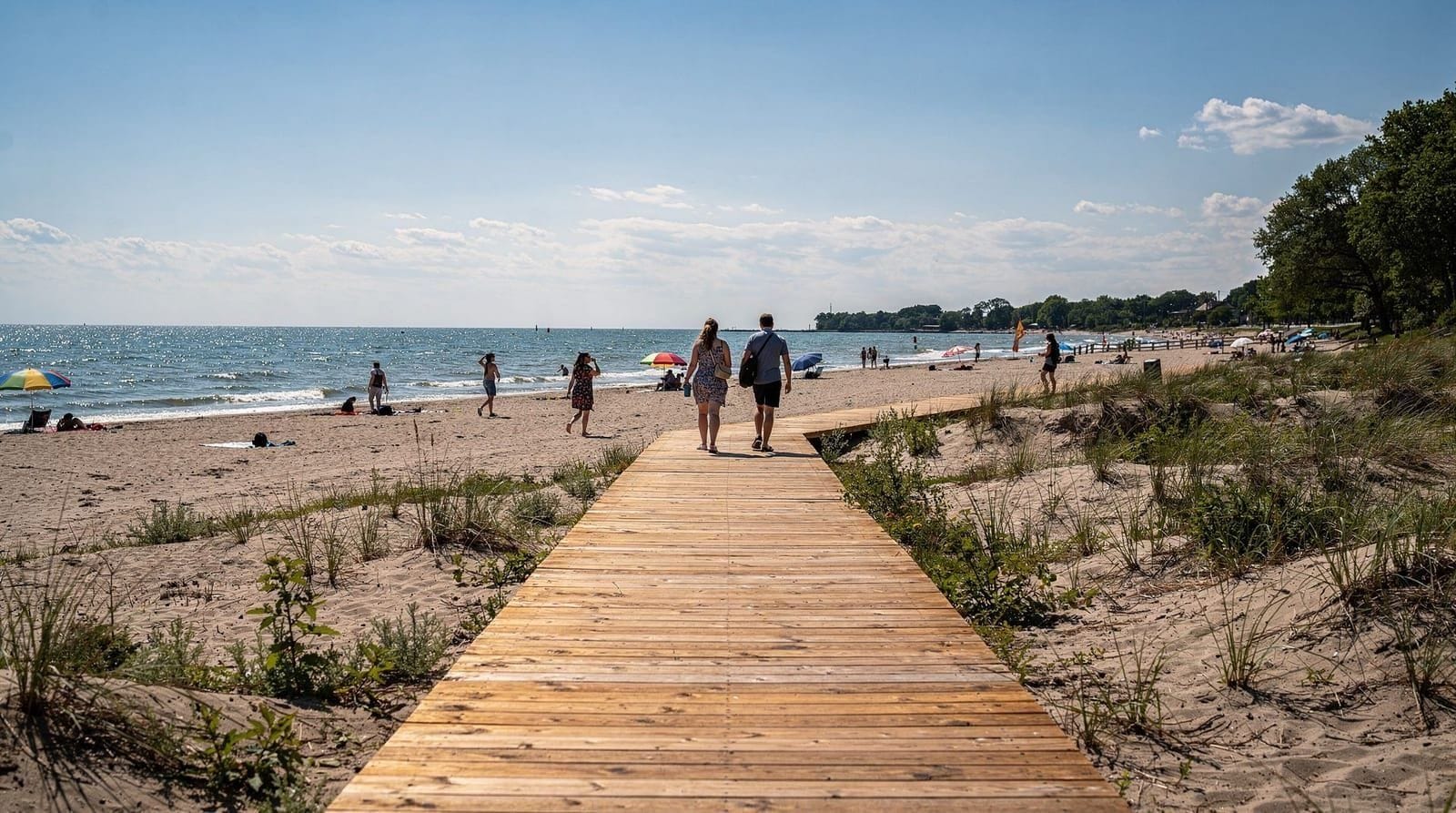
Toronto’s quietest realistic option, offering a residential, lakeside setting with a real boardwalk and swimming beaches, at the cost of a 20-25 minute commute to downtown by streetcar. Our guide to The Beaches covers what the neighborhood actually offers day to day. This is not a base for visitors who want to walk to the CN Tower each morning — it’s a base for visitors who want to experience a different, calmer side of the city and don’t mind commuting in for downtown sightseeing. Best for: families prioritizing outdoor space, longer stays, and travelers who’ve already done a downtown-focused trip and want something different.
A practical framework for deciding
If this is your first visit and you have three days or fewer, stay downtown — the convenience outweighs the trade-offs on a short trip. If you have four or more days, consider splitting your stay: a couple of nights downtown for the core sights, followed by a couple of nights in a neighborhood with more character — Queen West for nightlife, the Distillery District for atmosphere, or the Beaches for a change of pace. Budget travelers should look toward Kensington Market and the Annex rather than compromising on a lower-tier downtown hotel, since the neighborhood trade-off comes with more character, not less.
Timing matters as much as location
Hotel rates and availability shift dramatically around Toronto’s major annual events. TIFF in September pushes downtown and Yorkville rates up significantly and can sell out hotels weeks in advance — our TIFF Toronto guide covers what to expect. Pride in June and the Canadian National Exhibition in late August both create similar, if smaller, spikes. Booking 6-8 weeks ahead for a standard visit, and 3-4 months ahead for a trip overlapping any of these events, is the difference between reasonable rates and paying a real premium.
How the neighborhoods compare on airport access
Getting to and from Toronto Pearson International Airport is worth factoring into a neighborhood decision, particularly on a short trip where an extra 20-30 minutes each way adds up. The UP Express train, Toronto’s dedicated airport rail link, runs directly between Pearson and Union Station in about 25 minutes, departing every 15 minutes for most of the day — which means airport access for anyone staying downtown is really just “walk or take transit to Union Station,” a genuine advantage over almost every other neighborhood on this list.
Downtown core: The best airport access of any neighborhood covered here, since Union Station is the UP Express terminus. Door-to-door, allow about 45-60 minutes from a downtown hotel to the airport terminal, including a buffer for walking to the station and getting through security.
Yorkville: A 15-20 minute subway or taxi ride down to Union Station adds to the UP Express connection, putting total door-to-door time around 60-75 minutes — still very manageable, just not as immediate as staying downtown.
Distillery District and Corktown: Similar to Yorkville in total time, though a taxi or rideshare is often more practical here than transit, since reaching Union Station involves a streetcar plus a short walk rather than a direct line. Budget 60-75 minutes.
Queen West and King West: Well-served by streetcar down to Union Station, with total airport transit time landing around 60-70 minutes depending on which end of the neighborhood you’re starting from.
Kensington Market and the Annex: The longest transit-based airport trip on this list, since reaching Union Station requires a streetcar-and-subway or streetcar-and-walk combination rather than a direct line — budget 75-90 minutes via transit, or closer to 45-60 minutes by taxi or rideshare if traffic cooperates, which is often the more practical choice from this part of the city.
The Beaches: The longest commute on this list by a clear margin. Reaching Union Station takes 25-30 minutes by streetcar on a good day, before the UP Express leg even starts — total airport transit time often runs 90 minutes or more. Travelers basing themselves in the Beaches with an early flight should strongly consider a taxi or rideshare directly to the airport rather than routing through downtown transit.
For any neighborhood, the practical takeaway is the same: if you’re catching an early-morning flight, build in more buffer than a maps app suggests, since Toronto’s morning rush hour traffic and streetcar delays are real variables the UP Express itself doesn’t fully solve unless you’re already downtown.
It’s also worth noting that airport access works both ways: the UP Express advantage that makes downtown convenient for departures applies equally on arrival, which is a reasonable tiebreaker for travelers landing late at night or catching an early connection elsewhere in Canada the next morning. A traveler arriving at Pearson at 11pm and staying in the Beaches, by contrast, is looking at close to two hours door-to-door including the UP Express leg, the transfer, and the streetcar out — worth weighing against whatever savings a cheaper outer-neighborhood hotel offers, particularly on a short trip where that lost hour and a half is a meaningful share of total waking time in the city.
For travelers connecting through Toronto rather than ending their trip here, it’s also worth knowing that Billy Bishop Toronto City Airport, a smaller downtown airport primarily serving short-haul domestic and some U.S. routes, sits on an island just off the Harbourfront shoreline and is reachable from most downtown hotels in 15-20 minutes via a free pedestrian tunnel and ferry shuttle. It’s a genuinely different, faster experience than Pearson for travelers whose itinerary happens to route through it, and it’s one more reason downtown and Harbourfront-adjacent neighborhoods hold an edge over the outer options on this list for anyone juggling connecting flights within a short Toronto stopover.
Practical notes
- Transit access: Downtown, Yorkville, and the Distillery District all connect easily to the subway or streetcar network; the Beaches and outer Kensington-adjacent streets require slightly longer walks to reach transit.
- Noise: Queen West and King West are the loudest neighborhoods at night; the Beaches and Yorkville are the quietest.
- Value: Kensington Market and Annex-adjacent short-term rentals generally offer the best price-to-space ratio, especially for stays of four nights or more.
Whichever neighborhood you choose, Toronto’s transit network makes almost every part of the city reachable within 30 minutes, so the decision matters less for “can I get there” and more for what you want your mornings and evenings to feel like.
First trip vs. repeat trip: does the answer change?
A first-time, three-day-or-fewer visit almost always favors downtown or, budget allowing, Yorkville — the calculus is simple: you don’t yet know which of Toronto’s neighborhoods you’ll want more time in, so minimizing transit time to the CN Tower, St. Lawrence Market, and the Distillery District maximizes what you actually see.
Repeat visitors who’ve already covered the core often get more out of a stay in Queen West, Kensington Market, or the Beaches specifically because the trade-off — being a bit further from the postcard sights — matters less once you’ve already checked those off. If you’re torn, splitting a four-night stay into two downtown nights followed by two nights somewhere with more character is a genuinely low-risk way to sample both without fully committing to either.
Frequently asked questions about where to stay in Toronto
Is it better to stay downtown or in a Toronto neighborhood like Kensington Market?
Downtown offers the most convenience for first-time visitors, with the CN Tower, transit, and major sights all within walking distance. Kensington Market and Queen West offer more character and a lower-key, more local feel, but require more walking or transit to reach some downtown attractions.
Where should I stay in Toronto on a budget?
Areas slightly outside the core — near Kensington Market, in the Annex, or around the Junction — typically offer lower hotel and short-term rental rates than downtown or Yorkville, while remaining reachable by streetcar or subway in 15-20 minutes. Booking early matters more than neighborhood choice for keeping costs down during peak travel periods.
Where should families stay in Toronto?
Downtown near Harbourfront or the CN Tower area offers the easiest access to kid-focused attractions like Ripley’s Aquarium and the Toronto Islands ferry. The Beaches is a strong alternative for families prioritizing outdoor space and a quieter residential feel over central convenience.
Is Yorkville a good place to stay in Toronto?
Yes, if budget allows — it’s Toronto’s luxury hotel cluster, walkable to the ROM and AGO, and generally quieter at night than downtown’s Entertainment District. It’s less central for reaching the CN Tower and waterfront, both a 20-25 minute walk or short transit ride south.
What neighborhood should I avoid staying in as a tourist in Toronto?
Most central Toronto neighborhoods are safe for visitors. Areas directly around Moss Park and parts of Regent Park, east of downtown, see more visible homelessness and social services concentration and are generally not chosen by visitors as a base, though they’re not inherently dangerous during the day.
How far in advance should I book a downtown Toronto hotel?
Book at least 6-8 weeks ahead for a standard visit, and 3-4 months ahead if your trip overlaps with TIFF in September, Pride in June, or any major convention, all of which push downtown hotel rates up significantly and reduce availability across nearly every neighborhood covered in this guide.