Pearson Airport to downtown guide
What's the best way to get from Pearson Airport to downtown Toronto?
The UP Express train is the fastest and most predictable option, running direct from Terminal 1 to Union Station in 28 minutes for $12.35 CAD ($9.25 with a PRESTO card). A taxi or rideshare runs $40-55 CAD and takes 30-60 minutes depending on traffic; GO Bus 40 is the cheapest option at a longer 40-60 minutes.
Four ways to get downtown, and which one actually fits your trip
Toronto Pearson International Airport (YYZ) sits about 25 km northwest of downtown, and unlike some major airports, it has a genuinely fast, dedicated rail link — which makes the “how do I get downtown” question easier to answer here than in a lot of cities. Still, the right choice depends on your budget, how much luggage you’re carrying, and whether predictability matters more to you than cost. This guide breaks down all four real options with current prices and honest travel-time expectations.
| Fastest | UP Express, 28 minutes, $12.35 CAD ($9.25 with PRESTO) |
| Cheapest | GO Bus 40, 40-60 minutes, 24-hour service |
| Most convenient | Taxi/rideshare, $40-55 CAD, 30-60 minutes |
| Distance | Pearson sits about 25 km northwest of downtown |
| Booking | No advance booking needed for any transit option |
UP Express: the fastest, most predictable option
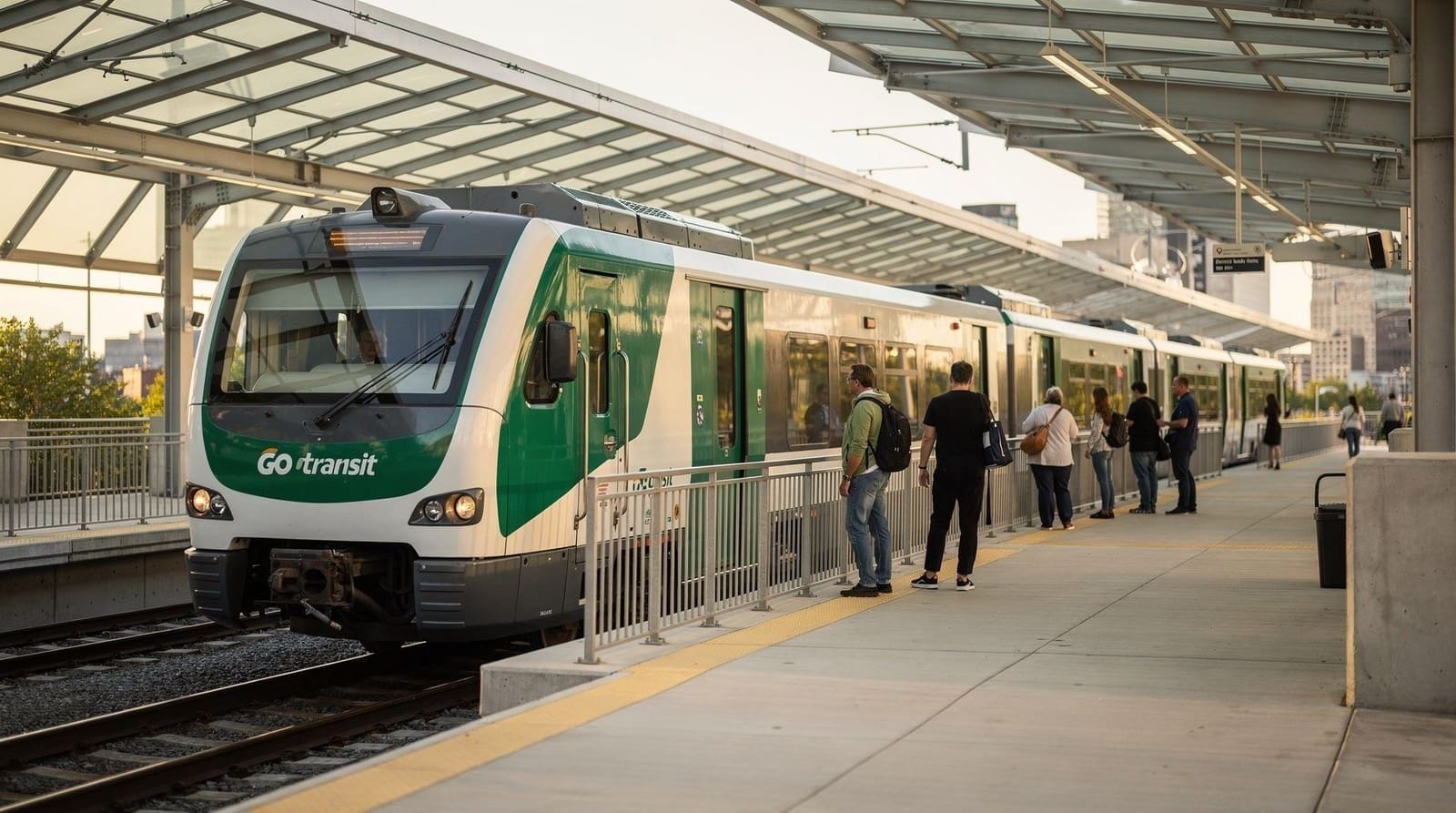
The UP Express (Union Pearson Express) is a dedicated train running non-stop between Pearson’s Terminal 1 (with a connecting shuttle bus from Terminal 3) and Union Station downtown, taking a reliable 28 minutes regardless of road traffic. Trains run every 15 minutes during normal operating hours, from early morning until midnight, making it a genuinely low-stress option if you’re arriving with a flight-dependent schedule and don’t want your ground transport time subject to highway conditions.
A one-way adult fare runs $12.35 CAD at the ticket machine or online, or $9.25 CAD if you’re using a PRESTO card (the same reloadable transit card used across the TTC and GO Transit — worth picking up if you’re staying in Toronto more than a day or two, since it also works on subway, streetcar, and bus fares). Trains have dedicated luggage racks, onboard WiFi, and level boarding, making it comfortable with checked bags or a stroller in a way a standard transit bus isn’t.
The one real limitation: UP Express only serves Union Station downtown. If your hotel or Airbnb is well outside the downtown core, you’ll need a connecting subway, streetcar, or taxi from Union Station to your final destination — still usually faster overall than driving the whole route by taxi through airport-access traffic, but worth factoring into your total trip time and cost.
GO Bus 40: the cheapest option
GO Transit’s Route 40 bus runs between Pearson and Union Station (with some trips continuing to other GTA stations), operating 24 hours a day — a genuine advantage if you’re landing on a very early or very late flight when UP Express or transit connections might have limited frequency. The trip takes 40-60 minutes depending on traffic and time of day, noticeably longer and less predictable than UP Express, but at a lower fare, particularly with a PRESTO card. See the GO Transit guide for how the wider GO network fits into a car-free Ontario visit beyond just the airport run.
Taxi and rideshare: convenience at a price
Licensed airport taxis and rideshare services (Uber and Lyft both operate at Pearson, with designated pickup zones at each terminal) run roughly $40-55 CAD to downtown, taking 30-60 minutes depending on traffic and time of day — rush hour on the 401 or Gardiner Expressway can meaningfully stretch this. This is the most convenient door-to-door option, particularly with heavy luggage, multiple travelers splitting the fare, or a hotel well outside downtown that would otherwise require a transit connection. It’s also the most expensive per person if you’re traveling solo, and the least predictable in terms of travel time given Toronto’s genuinely unpredictable highway traffic.
Rental car pickup at Pearson
If you’re renting a car for onward travel to Niagara, Muskoka, or elsewhere in Ontario rather than staying in Toronto proper, Pearson has a large on-site rental car facility served by a free shuttle from all terminals — see the renting a car in Ontario guide for what to expect at pickup and Ontario-specific driving rules. If your Toronto stay is downtown-focused, it’s generally not worth renting a car for the airport transfer itself, given parking costs and traffic downtown — better to rent later in your trip when you’re actually heading out to a region requiring a car.
Billy Bishop Airport: a different, closer alternative
If your flight routes through Billy Bishop Toronto City Airport (YTZ) instead of Pearson — common for some US connections via Porter Airlines — the calculation changes considerably. Billy Bishop sits just 1.5 km from downtown on the Toronto Islands, connected to the mainland by a short ferry or a pedestrian tunnel, both included in your arrival process at no extra cost. A taxi from Billy Bishop to most downtown hotels runs under 15 minutes and a fraction of the Pearson fare. If you have flight routing flexibility and your itinerary is downtown-focused, Billy Bishop is worth checking as an alternative to Pearson specifically for the shorter, cheaper, and more predictable transfer.
Comparing the options at a glance
For most downtown-bound visitors without heavy luggage constraints, UP Express is the best default: fastest, most predictable, and reasonably priced, especially with a PRESTO card. Budget travelers or anyone landing at an odd hour should consider GO Bus 40 instead. Groups of three or four splitting a fare, or anyone with substantial luggage and a hotel outside the immediate downtown core, often come out ahead with a taxi or rideshare despite the higher cost, simply from the door-to-door convenience and avoided transfers.
PRESTO card: worth getting at the airport?
PRESTO machines are available at Pearson’s UP Express stations, and loading one on arrival is a reasonable move if you’re planning to use Toronto’s TTC subway, streetcars, or buses during your stay beyond just the airport transfer — a single card covers UP Express, TTC, and GO Transit fares across your whole visit, saving you from juggling separate payment methods for each system. See the TTC transit guide for full details on PRESTO pricing versus single-ride tickets.
What to do if you’re delayed or arriving very late
UP Express and GO Bus 40 both run into the late evening, though frequency drops outside peak hours — check current schedules on the UP Express or GO Transit apps before you fly, since schedules can shift seasonally. If you’re landing after midnight or very early in the morning, a taxi or rideshare is generally the more reliable option, since transit frequency at those hours is limited and waiting at an empty platform after a long flight is rarely worth the fare savings.
Currency and payment notes for arrival
Pearson has currency exchange kiosks in the arrivals areas, though rates are typically less favorable than a bank or ATM withdrawal once you’re in the city — see the currency and tipping in Toronto guide for the better options once you’ve cleared arrivals. Credit and debit cards are widely accepted for UP Express, GO Bus, and rideshare payments, so you don’t strictly need Canadian cash in hand before leaving the airport, though having a small amount on hand for a taxi tip is worth arranging in advance if you’re not confident your card will work smoothly on arrival.
Traveling with kids, strollers, or mobility considerations
UP Express is genuinely the most accessible option among the transit choices — level boarding, dedicated luggage racks, and enough space to manage a stroller or wheelchair without the awkward step-up and narrow aisle of a standard bus. GO Bus 40 is a conventional coach-style bus, workable but less convenient with a folded stroller and bags in hand. If you’re traveling with young children on a long-haul flight and arriving fatigued, the extra cost of a taxi or rideshare for direct door-to-door service is often worth it purely for reduced hassle, even though UP Express remains faster in pure travel time.
The return trip: getting to Pearson for your departure
The same four options work in reverse, with one practical difference worth planning around: departure timing. UP Express and GO Bus 40 both run frequently enough that you don’t need to book in advance, but building in buffer time matters more on the way to the airport than arriving, since missing a flight is a considerably bigger problem than a slightly late hotel check-in.
For an international or long-haul departure, arriving at Pearson at least 2.5-3 hours before your flight is the standard recommendation, and working backward from that gives you your latest reasonable UP Express or taxi departure time from downtown. Rush hour traffic on the Gardiner Expressway or Highway 401 can meaningfully slow a taxi’s return trip during weekday morning and late-afternoon windows, another reason UP Express’s fixed 28-minute schedule is the safer bet if your flight timing is tight.
How Pearson’s transfer compares to other major airports
For travelers used to major international airports with poor or nonexistent rail links requiring an expensive taxi as the only real option, Pearson’s UP Express is a genuinely pleasant surprise — a fast, dedicated, reasonably priced rail connection is not something every comparably sized North American city offers. If you’re coming from a city where you’re used to budgeting an hour or more of unpredictable ground transport time, Pearson’s 28-minute fixed-schedule train is worth building into your arrival expectations as a meaningful upgrade over what you might be used to.
Frequently asked questions about getting from Pearson to downtown
How long does UP Express take from Pearson to Union Station?
28 minutes, non-stop, running every 15 minutes during normal operating hours regardless of road traffic conditions.
Is UP Express cheaper with a PRESTO card?
Yes — a PRESTO card fare runs $9.25 CAD compared to $12.35 CAD for a standard ticket purchased at the machine or online.
Is a taxi from Pearson to downtown expensive?
Taxi and rideshare fares typically run $40-55 CAD, taking 30-60 minutes depending on traffic — pricier than transit options but the most convenient for groups or heavy luggage.
Can I use PRESTO on GO Bus 40 from the airport?
Yes — GO Bus 40 accepts PRESTO card payment, and using one offers a fare discount over cash or single-ticket purchases, consistent with the rest of the GO Transit and TTC network.
Does UP Express run 24 hours?
No — UP Express runs from early morning until midnight with 15-minute frequency during normal hours. For very early or late arrivals outside this window, GO Bus 40 (24-hour service) or a taxi are the more reliable options.
Is Billy Bishop Airport a better option than Pearson for a downtown-focused trip?
If your flight routing allows it, yes — Billy Bishop sits just 1.5 km from downtown with a short, inexpensive transfer, compared to Pearson’s 25 km distance and higher transfer costs.
How far in advance should I book UP Express or GO Bus tickets?
Neither requires advance booking — both run frequently enough (every 15 minutes for UP Express, roughly every 20-30 minutes for GO Bus 40) that you can buy your ticket on arrival at the station or on the platform without meaningfully affecting your travel time.
Does Pearson have WiFi and charging stations while I wait for transport?
Yes — Pearson offers free WiFi throughout the terminals, and charging stations are available near most gate areas and in the arrivals halls, useful if you need to sort out ride details or hotel check-in logistics before heading downtown.
Do I need a rental car just for the airport transfer?
No — see the renting a car in Ontario guide for why it’s generally not worth renting for a downtown-focused stay; UP Express, GO Bus, or a taxi all handle the transfer itself more cheaply than parking downtown.