Kawartha Lakes
A chain of lakes, cottage towns and the Trent-Severn Waterway northeast of Toronto — planning a Kawartha Lakes trip for boating, fishing and lake days.
Toronto Highlights Walking Tour with Tower Entry
Quick facts
- Distance from Toronto
- 1.5-2 hours (140 km) by car
- Main towns
- Lindsay, Bobcaygeon, Fenelon Falls
- Known for
- Cottage country, boating, and the Trent-Severn Waterway
- Number of lakes
- The Kawartha chain includes over a dozen connected lakes
Cottage country without the Muskoka price tag
Kawartha Lakes is Ontario’s other major cottage-country region — less internationally known than Muskoka, but closer to Toronto and, by reputation, more affordable for renting a cottage or a boat for the weekend. The name covers both a specific municipality (the City of Kawartha Lakes, formed by amalgamating several smaller towns and townships in 2001) and the broader chain of interconnected lakes that spreads across the region, linked by the historic Trent-Severn Waterway.
The word “Kawartha” is generally understood to derive from an Anishinaabe phrase describing a place of “bright waters and happy lands,” and the region’s identity has centered on exactly that combination since cottaging took off here in the early 20th century.
The lake chain and the Trent-Severn Waterway
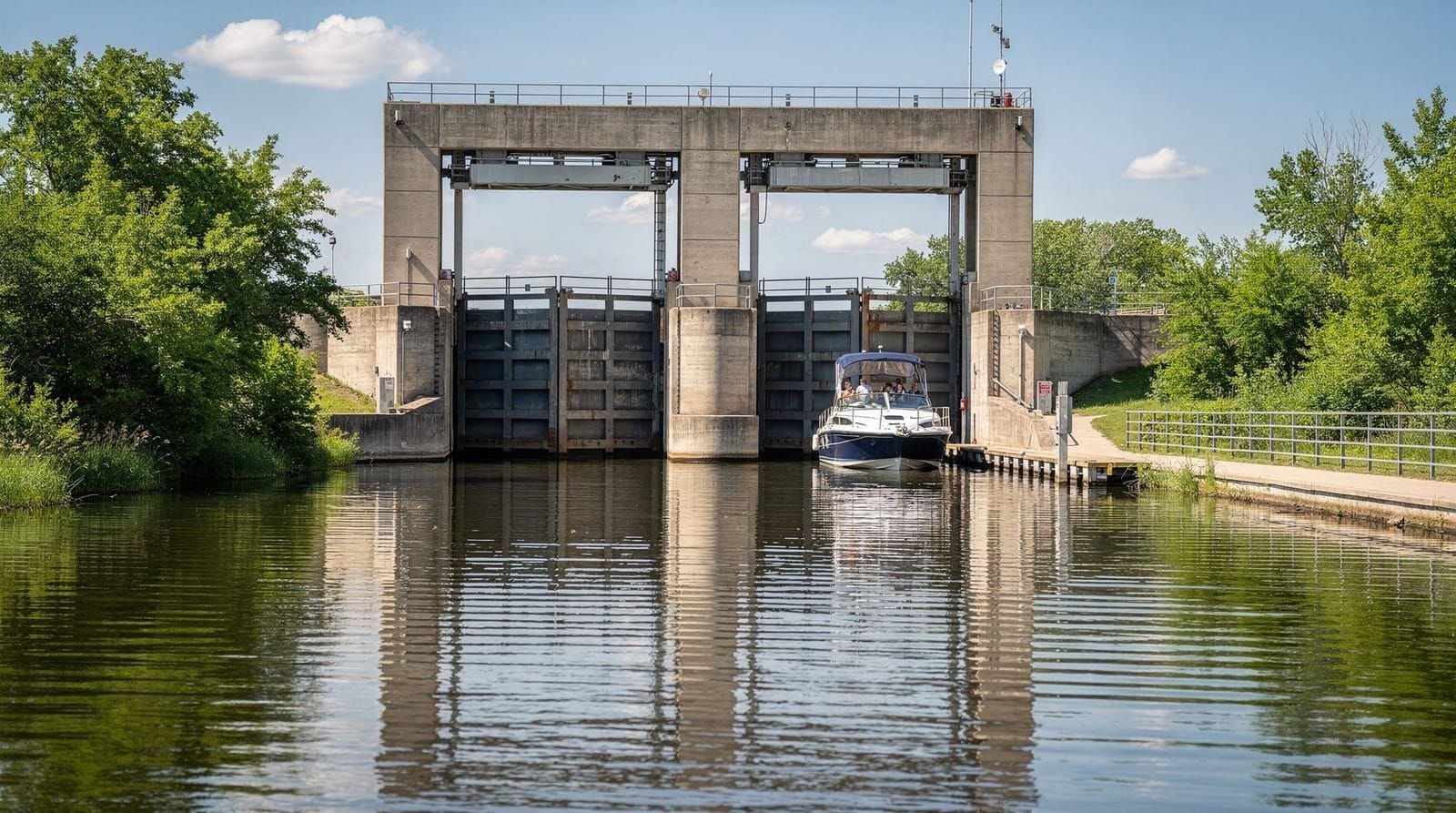
More than a dozen connected lakes make up the Kawartha chain, linked through the Trent-Severn Waterway, a historic canal system running from Lake Ontario to Georgian Bay via a series of locks that let boats travel between lakes that would otherwise be separated by land. That connectivity is central to how the region is used: boaters can travel for days through the chain via a sequence of locks, and the waterway’s swing bridges and lift locks (including the famous one in nearby Peterborough) are attractions in their own right for visitors who aren’t boating themselves.
Bobcaygeon
Bobcaygeon, often cited as one of the more scenic small towns in the region, sits at the junction of several lakes and has a lock right in the middle of downtown — a genuinely unusual bit of civic geography that means you can watch boats being raised or lowered while having lunch on Main Street. The town’s Lock 32, part of the Trent-Severn system, is one of the busiest in the chain during peak summer boating season.
Fenelon Falls
Fenelon Falls takes its name from an actual waterfall running through the middle of town, connecting Cameron Lake to Sturgeon Lake — a small but photogenic drop that gives the town its identity and its own lock station. Like Bobcaygeon, it’s a compact, walkable town built around the water, with a summer-driven economy of shops, restaurants, and marinas.
Lindsay
Lindsay, the largest town in the Kawartha Lakes municipality, functions more as a service and shopping hub for the surrounding cottage communities than as a lakeside destination itself, though it has its own historic downtown and is the practical stop for groceries and supplies before heading further out to a rented cottage.
Fishing and boating
The Kawartha Lakes region has a long-standing reputation among Ontario anglers for bass and walleye fishing, and much of the local tourism economy — marinas, bait shops, fishing guides — is built around that reputation. Boat rentals are widely available across the region’s towns, from pontoon boats for a slow lake cruise to fishing boats for a more serious day on the water.
Getting there from Toronto
The drive to the region’s towns runs about 1.5–2 hours (roughly 140 km to Lindsay, somewhat further to Bobcaygeon or Fenelon Falls) via Highway 401 and Highway 115/35. There’s no direct rail or bus service into the smaller lake towns, so a car is effectively required — this is a driving-and-boating destination rather than one built around transit access.
How Kawartha Lakes compares to Prince Edward County
Travelers weighing a Kawartha Lakes weekend against a wine-country trip to Prince Edward County are really choosing between two different kinds of slow weekend. Kawartha Lakes is built around the boat and the dock — a rented pontoon, a lock to watch, a fishing rod in the water. Prince Edward County is built around the table — wineries, farm-to-table restaurants, and sandy beaches rather than a chain of connected lakes.
Both sit within a comparable driving distance of Toronto, and neither requires backtracking through the city if you’re continuing on toward Kingston and the Thousand Islands. If a rented boat and a slower, marina-town pace matters more than a wine list, Kawartha Lakes is the better weekend.
Renting a cottage versus a marina-town hotel
Most first-time visitors default to booking a lakeside cottage, but the region’s small towns also have standard motels and B&Bs directly in Bobcaygeon or Fenelon Falls, which suit a shorter one- or two-night visit better than a full cottage rental with a minimum-stay requirement. A cottage makes sense for a group splitting the cost over three or more nights with its own dock and kitchen; a town-based room makes more sense for a couple wanting to walk to dinner and a lock-watching bench without arranging their own boat.
A quieter alternative to Muskoka
Because Kawartha Lakes doesn’t carry the same brand recognition as Muskoka, it tends to draw a different, often more budget-conscious crowd — cottage rentals and marina fees here are generally less expensive than Muskoka’s more upscale lake communities, while the boating and fishing experience is comparable. It’s a genuine trade-off worth knowing about if you’re choosing between the two regions for a lake weekend.
When to visit
June through early September is peak season, with the Trent-Severn Waterway’s locks operating on their full summer schedule and lake water warm enough for comfortable swimming. Fall brings a quieter, cooler alternative with good foliage along the shorelines, though many of the smaller marinas and rental operations wind down after Labour Day.
A slow weekend, hour by hour
The best Kawartha Lakes weekends are the ones with almost nothing scheduled. A typical shape: arrive on Friday evening, settle into the cottage or room, and keep the first night simple — a walk along the water, an early dinner, and no alarm. Saturday is for the lake itself: a rented boat in the morning while the water is calm, a lock-side lunch in Bobcaygeon, and a lazy afternoon at the dock or on the shoreline. Sunday is for the drive home, ideally with one stop on the way, such as the lift lock in Peterborough.
The point of the region is that the pace is the product. If you try to see every town in one weekend, you spend the trip in the car and lose what makes the place worth visiting. Pick one lake or one town as your base and let the rest be a bonus.
What to do when you are not on a boat
Not everything here depends on a rental. Lock stations are free entertainment: boats queue up, the gates open, and the water level changes while people watch from the walkways. Small-town main streets reward an unhurried wander, with local shops, ice cream stands and patios facing the water. Swimming spots, shoreline walks and picnic stops fill the gaps, and a good fishing rod in the trunk often turns an empty hour into the best part of the day.
Rainy days are slower but not wasted. Cafés, antique and gift shops, and a long lunch cover a grey afternoon, and the lakes themselves look quieter and moodier under cloud. If the forecast is poor for the whole weekend, a city day is a fair fallback — see things to do in Toronto on a rainy day for ideas closer to home.
Planning the drive and the stops
A car is the way in, and the route out of Toronto is straightforward, but weekend traffic on summer Fridays can stretch the trip, so leaving before the evening rush or after it makes a noticeable difference. If you do not own a car, read the guide to renting a car in Ontario before you book, and check how airport arrivals connect in the Pearson airport to downtown guide if you are flying in first.
Buy groceries and supplies in Lindsay before heading out to a rented cottage; the smaller lake towns have shops, but the choice is narrower. If you have a spare day on either end of the trip, a few hours in the city makes a good bookend — a guided walk through the downtown highlights with a tower visit works well on the day you arrive or leave, and the downtown Toronto walking guide covers the same ground on your own.
Choosing between the lake regions
Ontario offers several lake-and-cottage options, and they feel different. Muskoka is the polished, resort-style choice with a stronger brand; the Muskoka day trip guide and things to do in Muskoka show what that looks like. Algonquin Park is wilderness, with canoe routes and campsites rather than marinas and patios; if that appeals more, a guided day trip from Toronto into Algonquin is an easy way to sample it, and the Muskoka versus Algonquin comparison helps you decide. Kawartha Lakes sits between these in mood: more relaxed than Muskoka, more comfortable than the backcountry.
For a sense of how a longer cottage-country trip fits together, the Muskoka cottage country escape itinerary and the Ontario road trip itineraries are useful models, and renting a cottage versus a hotel is a practical read before you commit to either.
Travelling with family or friends
A lake weekend suits groups because the cost and the chores can be shared. Families benefit from a dock, a kitchen and a place for children to swim without a schedule. Friends get a base for fishing, card games and evening fires. Whichever you are, agree early on who is driving the boat, who is cooking, and what the plan is if the weather turns, since a boat day lost to wind is easier to take when there is a backup. The family day trips from Toronto guide has more ideas for keeping younger travellers busy.
Practical notes
Because the region is spread across a wide area of small towns and lake communities, planning matters more here than in a single-town destination — decide which lake or town you’re basing around before booking accommodation, since driving between the different parts of the Kawartha chain can add up over a short trip. Cottage and marina bookings for peak summer weekends should be made well in advance, as availability tightens considerably from June through August.
Kawartha Lakes by season
| Season | Water & weather | What’s open | Crowds |
|---|---|---|---|
| June–August | Warm enough for swimming, full boating season | Locks, marinas, boat rentals all running | Busiest, especially long weekends |
| September | Cooling, still comfortable on the water | Most marinas still operating on reduced hours | Noticeably thinner |
| October | Too cold to swim, good foliage on the shorelines | Many rental operations closed for the season | Quiet |
| Winter | Frozen lakes, no boating | Towns largely dormant; a handful of shops/restaurants stay open | Very quiet |
Frequently asked questions about Kawartha Lakes
Is Kawartha Lakes cheaper than Muskoka for a cottage rental?
Generally, yes — the region doesn’t carry the same premium brand recognition as Muskoka, and cottage and marina costs tend to run lower for a comparable lake experience, though prices vary widely by specific property and lake.
What’s the difference between Kawartha Lakes and Peterborough?
Peterborough is a city that functions as the gateway and service hub for the Kawartha Lakes region, while Kawartha Lakes itself refers to the broader chain of lakes and smaller cottage towns spreading north and west of the city.
Do I need a boat to enjoy Kawartha Lakes?
No — towns like Bobcaygeon and Fenelon Falls are walkable and scenic in their own right, with lock-watching, shops, and restaurants accessible without a boat. That said, boating (rented or borrowed) is the activity most closely associated with the region and opens up a lot more of the lake chain.
What is the Trent-Severn Waterway?
A historic canal system connecting Lake Ontario to Georgian Bay via a chain of lakes, rivers, and 44 locks, originally built for transportation and now used almost entirely for recreational boating. Several of its most interesting lock stations, including a famous hydraulic lift lock, run through the Kawartha Lakes region.
When is the best time for fishing in the Kawarthas?
Late spring through early fall covers the main fishing season for bass and walleye, with early summer generally considered a strong window as water temperatures rise and fish become more active.