Distillery District history guide
Distillery District Historic Walking Tour
What was the Distillery District before it became a tourist area?
It was the Gooderham and Worts distillery, once the largest whisky distillery in the British Empire, operating on the site from 1832 until the 1990s. The Victorian industrial buildings were preserved rather than demolished, and the pedestrian-only precinct opened to the public as galleries, restaurants, and shops in 2003.
From the British Empire’s largest whisky distillery to a pedestrian arts district
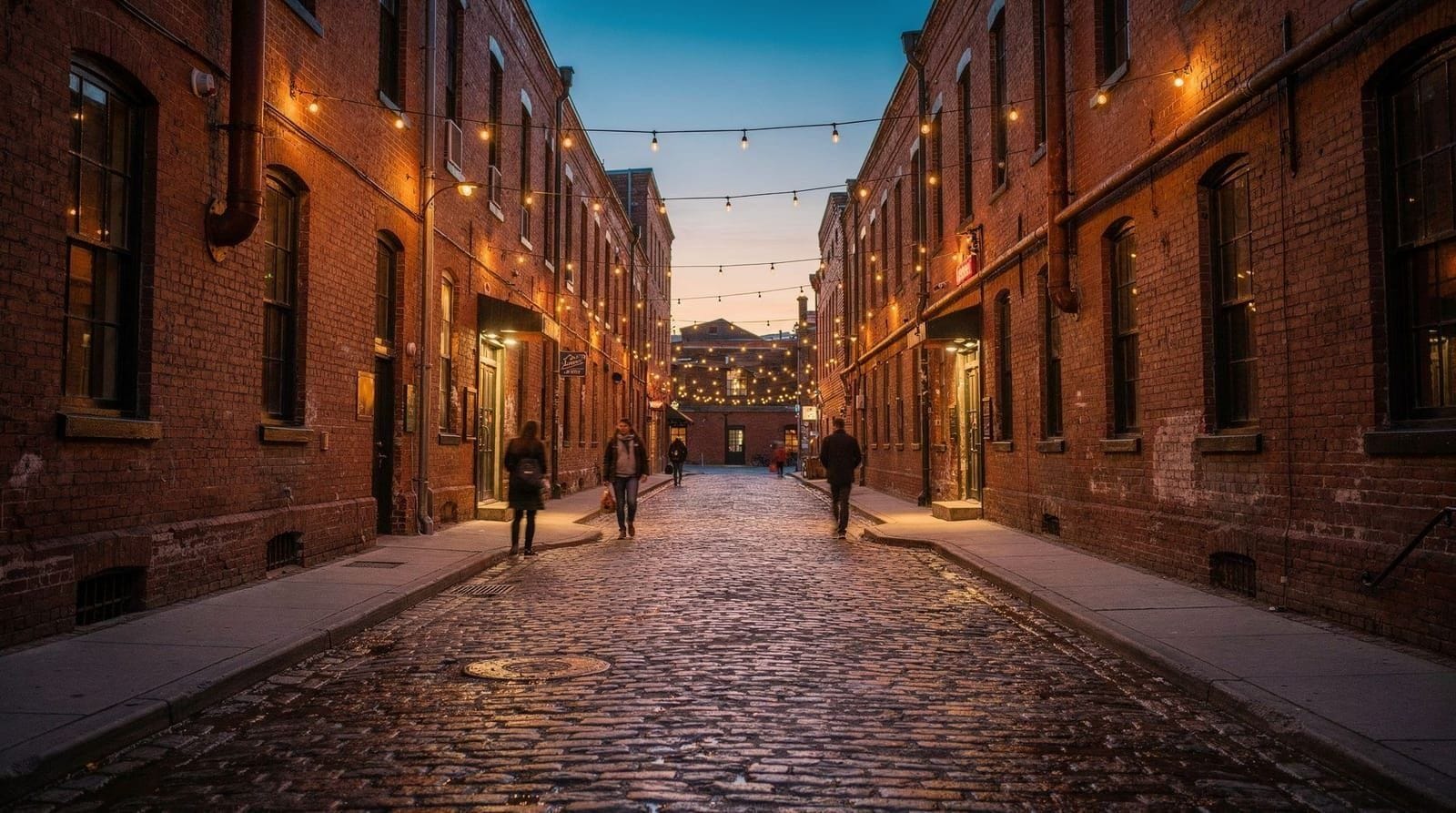
Most visitors who wander the cobblestone lanes of the Distillery District know it as a photogenic spot for galleries, patios, and the annual Christmas Market — fewer know that the red-brick Victorian buildings around them once formed the largest whisky distillery in the British Empire. Understanding that history changes how the district reads: it’s not a themed retail development built to look historic, it’s a genuinely preserved 19th-century industrial site that happens to now house shops and restaurants instead of stills and warehouses.
| At a glance | Detail |
|---|---|
| What it was | The Gooderham and Worts distillery, once the largest in the British Empire |
| Founded | 1832, as a windmill and flour operation on the Lake Ontario shoreline |
| Production ended | 1990; buildings sat largely vacant through the decade |
| Reopened | 2003, as a pedestrian-only arts and culture precinct |
| Scale | Roughly 40 heritage buildings across about 13 acres; National Historic Site (designated 1988) |
| Best time | Weekday mornings for quiet lanes and clear light; avoid the November-December market crush if history is your focus |
The Gooderham and Worts distillery
The site’s story starts in 1832, when English miller James Worts and his brother-in-law William Gooderham built a windmill and flour business on the Lake Ontario shoreline (the lake has since receded considerably from where it stood then). Distilling whisky from surplus grain became a profitable side business, and by the late 1800s, Gooderham and Worts had grown into the largest distillery in the British Empire, exporting whisky globally and building out the dense complex of red-brick warehouses, malt houses, and production buildings that still stands today.
The company survived Prohibition-era disruptions in the US (Canadian distilleries famously supplied much of the whisky smuggled south during American Prohibition) and continued operating on the site in various corporate forms until production finally ceased in 1990. For over a decade after that, the buildings sat largely vacant — a genuine stroke of luck for preservation, since the site’s rundown state in the 1990s made it a popular filming location for period movies (its historic authenticity, ironically, was easier to access precisely because nobody had modernized it) before a private redevelopment group acquired and restored it.
Why the buildings survived when so much industrial Toronto didn’t
Toronto demolished a considerable amount of its Victorian industrial architecture through the mid-20th century, which makes the Distillery District’s survival somewhat unusual. Two factors mattered: the site’s relative isolation east of the core downtown core meant it wasn’t under the same redevelopment pressure as more central lots, and by the time serious development interest arrived in the early 2000s, heritage preservation had become a stronger civic priority than it had been decades earlier.
The result is what’s now recognized as North America’s largest and best-preserved collection of Victorian-era industrial architecture — over 40 buildings across roughly 13 acres, all restricted to pedestrian traffic since the district’s 2003 reopening.
What the individual buildings were originally used for
Walking the district with this context adds real depth to what would otherwise be a pleasant but generic-feeling cobblestone stroll. The Rack House buildings, several of which now hold galleries and studios, stored aging whisky barrels — the name comes directly from the wooden racks used to hold barrels during the aging process. The Cannery Building processed and stored goods related to the distillery’s broader operations. Mill Street Brewery, one of the district’s most visited stops today, occupies part of the original production complex and leans into the historical continuity by brewing on-site rather than simply trading on the location’s whisky history.
For a guided walk that connects the architecture directly to the distillery’s operational history, rather than piecing it together from scattered plaques:
Distillery District historic walking tourFrom industrial site to arts and culture destination
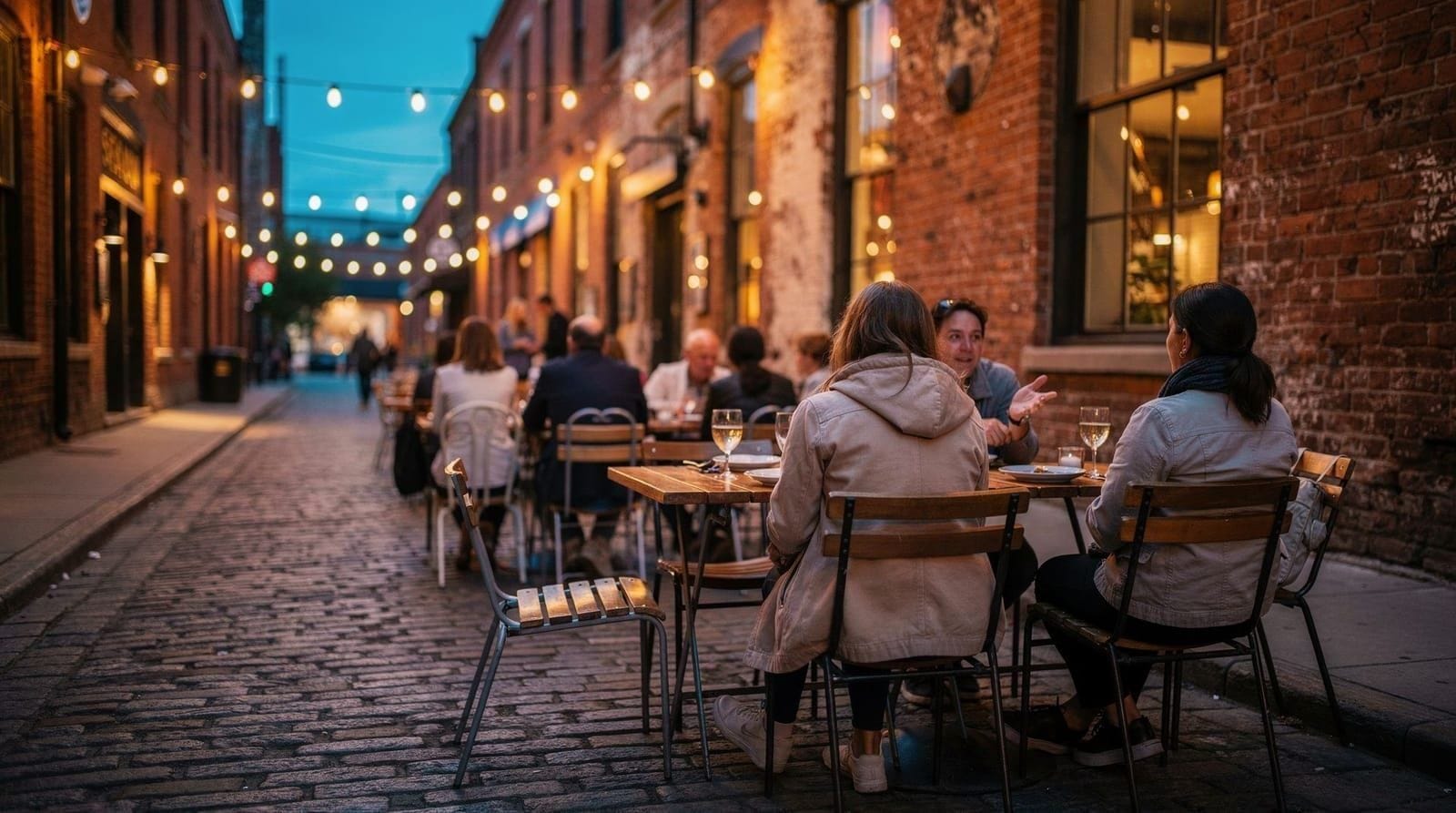
The district’s 2003 transformation deliberately prioritized galleries, artist studios, and independent shops over chain retail in its early years, a positioning that’s shifted somewhat as rents have risen and larger operators have moved in, but the core character — art installations, small design boutiques, and a genuinely walkable, car-free layout — has held up better than in many similarly redeveloped historic districts elsewhere in North America. The district hosts the Toronto Christmas Market each November and December, one of the city’s most visited seasonal events, drawing on the same Victorian industrial backdrop for a genuinely atmospheric holiday market setting.
Architecture worth noticing
Beyond the general red-brick aesthetic, look for the varied roofline styles across different building eras (the complex was built and expanded over roughly seven decades, not all at once, so the architectural details shift building to building), the surviving cast-iron support columns visible in several of the larger gallery spaces, and the cobblestone streets themselves, which are original rather than a later decorative addition. The district’s heritage designation protects the exterior facades and street layout, which is why — unlike many redeveloped industrial sites — the overall footprint and building massing still closely resembles historical photographs from the distillery’s operating years.
Getting there and pairing with other historic Toronto sites
The Distillery District sits a 10-15 minute walk east of St. Lawrence Market, another genuinely historic Toronto site (the market building itself dates to the 1800s), making a combined half-day of two distinct pieces of 19th-century Toronto history a reasonable pairing — see the guide to St. Lawrence Market for what to prioritize there. Downtown Toronto and Old Town sit within a similar walking radius if you want to extend the historical thread further.
The distillery’s role in Canadian whisky history more broadly
Gooderham and Worts wasn’t just a large operation locally — it was, for a stretch of the 19th century, a genuine influence on how whisky was produced and exported across the British Empire and into the United States. The company pioneered production techniques and scale that smaller Canadian distillers couldn’t match, and its exports helped establish Canadian whisky’s international reputation decades before the more famous American Prohibition-era smuggling stories that later cemented it in popular memory. Several of the district’s interpretive plaques and the Distillery Historical Museum, a small but genuinely worthwhile stop within the district, cover this broader trade history in more depth than the architecture alone conveys.
Heritage designation and what it actually protects
The Distillery District received National Historic Site of Canada designation in 1988, before the redevelopment that created today’s pedestrian precinct, which is part of why the restoration prioritized preserving original facades, street layouts, and structural details rather than a looser “historically inspired” renovation. This designation legally constrains what can be altered on the exterior of the heritage buildings, which is why — even as individual tenants inside have changed considerably since 2003, from galleries to restaurants to retail — the overall streetscape has stayed remarkably close to how it appeared in historical photographs from the distillery’s operating decades.
Public art and its relationship to the historic buildings
Beyond the preserved architecture itself, the district has become a genuine outdoor gallery, with large-scale public art installations and rotating sculpture placed throughout the cobblestone lanes — most visibly the illuminated “Love” sculpture near the district’s Trinity Street entrance, one of the most photographed public art pieces in Toronto. These installations are deliberately contemporary, creating a visual contrast against the Victorian brick backdrop that’s become part of the district’s identity rather than feeling at odds with the historical setting.
Guided walking tours vs. self-guided history hunting
Beyond the dedicated historic walking tour, several information panels are scattered throughout the district covering individual buildings’ original functions, though they’re easy to walk past without noticing if you’re not specifically looking for them. A guided tour condenses this scattered information into a coherent narrative and typically covers details — like specific building dates, the mechanics of 19th-century whisky production, and the site’s Prohibition-era export history — that the on-site panels only touch on briefly.
Best time to visit for the history-focused visitor
Weekday mornings offer the quietest window to actually read the interpretive plaques scattered throughout the district and take in the architecture without navigating crowds — weekends, particularly during the Christmas Market season, get genuinely dense with foot traffic that makes lingering over the historical details harder. If architecture and history are your primary interest rather than shopping or dining, a weekday visit outside the November-December market season is the better call.
Restoration philosophy: what changed and what stayed original
The 2001-2003 restoration that created today’s public district deliberately preserved as much original material as structurally possible — original brick, timber framing, and cast-iron elements were retained and repaired rather than replaced wherever feasible, with new mechanical, electrical, and accessibility systems threaded discreetly through the existing structures rather than requiring visible modern additions.
This approach is part of why the district reads as genuinely historic rather than a themed reconstruction; unlike some heritage-adjacent retail developments that gut interiors while preserving only a facade, much of the Distillery District’s structural fabric — floors, beams, and brickwork you can touch — is the same material that stood through the distillery’s operating century.
Comparing the Distillery District to other Toronto historic sites
Toronto has relatively few large-scale surviving industrial heritage sites compared to some other North American cities of similar size, which makes the Distillery District’s scale genuinely significant rather than simply pleasant. St. Lawrence Market’s building dates to a similar era but represents commercial rather than industrial architecture, and Casa Loma represents a single wealthy family’s domestic architecture rather than a working industrial complex. Together, the three sites offer distinct windows into different aspects of 19th and early 20th-century Toronto — commercial, industrial, and domestic — worth understanding as complementary rather than redundant if you’re building a history-focused day around the downtown core.
The buildings, decoded
Half the pleasure of the district is realising the names aren’t decorative — they describe what each structure actually did. A quick key turns a generic cobblestone stroll into a readable industrial site.
| Building / feature | Original function | What it holds now |
|---|---|---|
| Rack House buildings | Stored aging whisky barrels on wooden racks | Galleries and artist studios |
| Cannery Building | Processed and stored distillery-related goods | Event and retail space |
| Mill Street Brewery premises | Part of the original production complex | A working brewery, on-site |
| Cobblestone streets | Original industrial roadway, now pedestrian-only | The district’s protected streetscape |
| ”Love” sculpture (Trinity Street) | — (contemporary addition) | One of Toronto’s most-photographed public artworks |
For where to eat once you’ve walked the history, the best restaurants in the Distillery District guide covers the current tenants, and the guide to the Distillery District rounds out shops, galleries and seasonal events like the Christmas Market.
Frequently asked questions about Distillery District history
What company originally operated the Distillery District?
Gooderham and Worts, which grew from a modest 1832 windmill and flour operation into the largest whisky distillery in the British Empire by the late 1800s, operating on the site continuously until production ceased in 1990.
When did the Distillery District open to the public as it exists today?
The pedestrian-only arts and culture precinct opened in 2003, following a private restoration of the historic buildings that had sat largely vacant through the 1990s.
Why is the Distillery District car-free?
The district’s redevelopment plan restricted vehicle traffic to preserve the original cobblestone streets and create a genuinely walkable pedestrian precinct, distinguishing it from most redeveloped urban sites that retain vehicle access.
Is Mill Street Brewery connected to the original distillery?
Mill Street occupies part of the original Gooderham and Worts production complex and brews on-site, leaning into the site’s historical continuity, though it’s a separate, more recent business rather than a direct successor to the original whisky operation.
How many original buildings survive in the Distillery District?
Roughly 40 heritage buildings across 13 acres survive, making it North America’s largest and best-preserved collection of Victorian-era industrial architecture.
Is the Distillery District worth visiting just for the history, not the shops?
Yes, particularly on a quiet weekday morning — the architecture and layout are genuinely significant on their own, and a guided historic walking tour surfaces context that’s easy to miss browsing independently.
Is there a dedicated museum within the Distillery District?
A small Distillery Historical Museum operates within the district, covering the site’s whisky production history and the Gooderham and Worts story in more depth than the scattered interpretive plaques alone.
What’s the best time of day to photograph the historic architecture?
Early morning, before the district gets busy with shoppers and diners, offers the clearest sightlines down the cobblestone lanes and the best light on the red-brick facades, particularly in the hour or two after sunrise during spring and fall.
Top experiences
Bookable activities with verified prices and instant confirmation on GetYourGuide.